Powdery Mildew on Cannabis: Visual Detection and Prevention
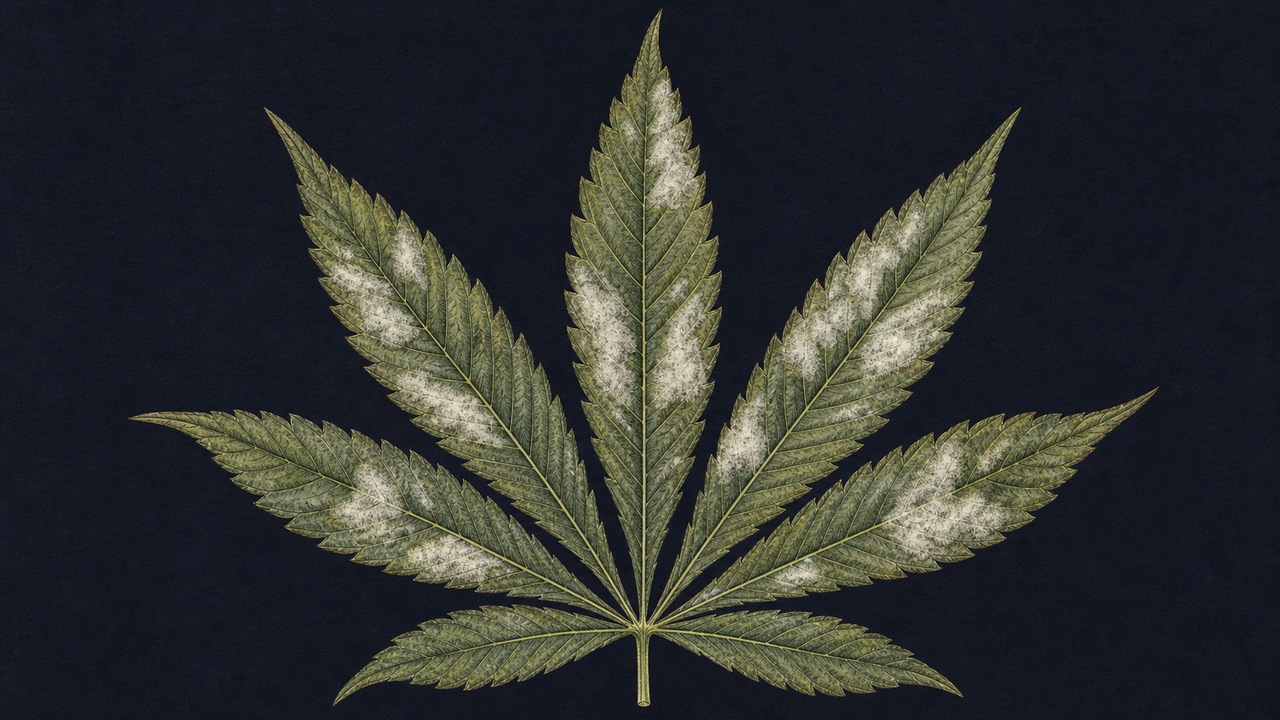
It looks like your plant is getting frosty. White powder spreading across the leaves, that pale shimmer catching the grow light. Then you touch it, and your finger comes away white.
That’s not trichome development. That’s powdery mildew - and if you’re seeing it now, the infection has been active inside your plant for up to two weeks already.
Powdery mildew is one of the most misidentified conditions in cannabis cultivation - not because the advanced stage is hard to recognize, but because early-stage colonies genuinely look like trichome buildup to the untrained eye. Growers see white on their leaves and feel reassured rather than alarmed. By the time the mistake is obvious, the fungus has spread.
This guide covers visual identification at every stage, how to distinguish PM from trichomes and other lookalikes, and what to do when you find it.
Quick Identification
Powdery mildew on cannabis appears as white, flour-like patches on leaf surfaces that transfer to your finger when touched. Unlike trichomes - which are crystalline, sticky, and firmly attached - powdery mildew is fuzzy, powdery, and wipes off. It typically starts on older, lower leaves and can spread from a single infected plant to your entire grow within 5-10 days under favorable conditions.
Quick checklist:
- White powdery patches on leaf surfaces (usually upper side)
- Fuzzy texture, not crystalline or glittery
- Transfers to your finger when touched
- Wipes off with cloth (trichomes stay attached)
- Started on older, lower leaves
- Circular colony patterns, expanding outward
Why Powdery Mildew Is So Destructive
The Timing Problem
Powdery mildew is caused by obligate biotrophic fungi - primarily Golovinomyces species (formerly classified as Erysiphe) - that require a living plant host to survive. As an obligate biotroph, the fungus spends its first 7-10 days growing inside plant tissue, establishing a mycelial network before producing the visible white sporulation on the surface.
The practical implication: by the time you see powdery mildew, you’re already two weeks behind.
This timing overlaps with the worst possible moment in the grow cycle. PM typically produces visible symptoms approximately two weeks into flowering - when plants are at their most developed and most valuable. A disease that becomes visible at week two of a nine-week flower has seven weeks to damage a mature crop.
The Spread Problem
Once sporulating, powdery mildew spreads through airborne spores called conidia. Unlike many fungal diseases that require water droplets to spread, PM spores travel through air and remain viable in typical grow room conditions. A single infected plant can contaminate an entire facility within 5-10 days.
This is not a slow disease. It spends two weeks being invisible, then spreads rapidly.
Visual Symptoms by Stage
Days 1-7: No Visible Symptoms
The fungal network is developing inside plant tissue. Nothing is visible externally. The only detection method during this phase is molecular PCR testing - available commercially but not practical for most growers as a daily routine.
What to do: Prevention only. No reactive treatment exists for pre-symptomatic infection.
Days 7-14: Early Visible Stage
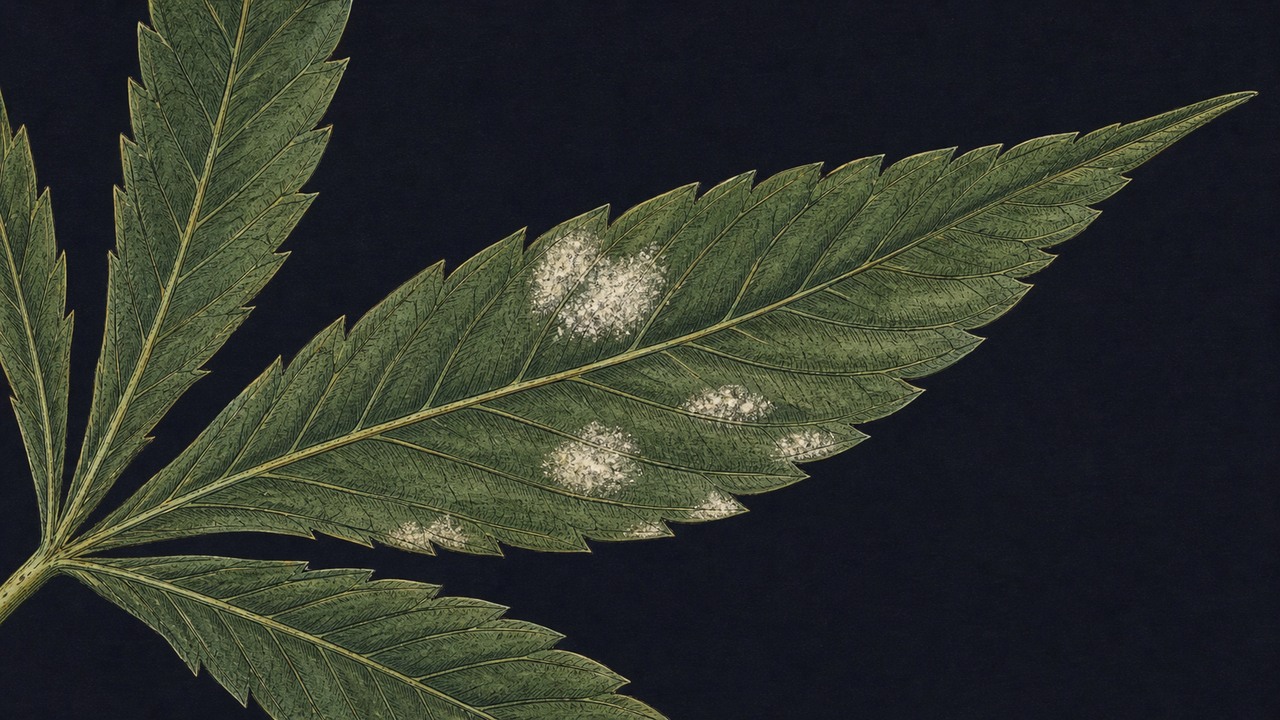
What you see:
- Fine white coating on upper leaf surface, often concentrated near veins
- Circular “chalk-dust rings” as colonies grow radially from infection points
- Small, discrete white spots (1-5mm diameter) resembling flour or powdered sugar
- Patches separated by healthy-looking green tissue initially
This is when intervention is most effective. Catching PM at this stage - and responding within 48 hours - gives you the best chance of containing the infection before airborne spread reaches other plants.
Days 14+: Advanced Stage
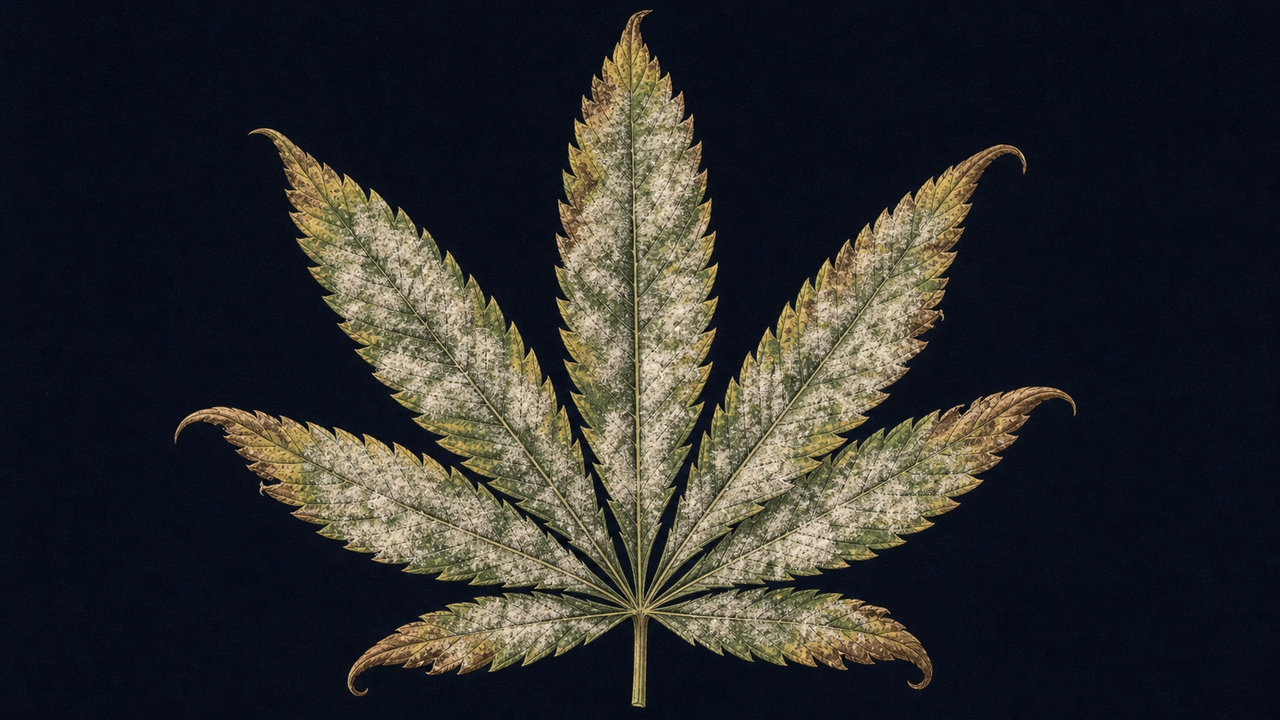
What you see:
- Spots grow larger and merge into confluent white coverage
- Thick, prominent coating across entire leaf surfaces
- Fuzzy, hair-like texture that can resemble spider webs or white cotton candy in severe cases
- Affected leaves turn yellow (chlorosis) as photosynthetic capacity is reduced
- Leaf death and necrosis in severely affected tissue
- Contamination of flower bracts and bud sites
At this stage, individual plant treatment may still limit damage, but facility-wide spread is likely already underway.
Where to Look: Detection Hotspots
Not all areas are equally at risk. Focus visual inspections here:
Check first:
- Upper surfaces of older, lower leaves
- Corners with poor airflow
- Areas where leaves touch each other
- Near the base of the plant
Check second:
- Lower leaf surfaces
- Leaf petioles and stems
- Flower bracts and bud sites
- Plants adjacent to any previously infected individual
High-risk conditions:
- Humidity above 60% (optimal for PM at 95%+)
- Temperature 68-86°F (20-30°C)
- Poor air circulation or stagnant air pockets
- Overcrowded plants with leaf-on-leaf contact
- Recently introduced plant material (a common entry point)
One counterintuitive note: many growers assume low humidity prevents powdery mildew. It slows initial infection, but once PM is established, the fungus can continue growing even below 50% relative humidity. Humidity reduction is a preventive tool, not a cure.
Powdery Mildew vs. Trichomes: The Critical Distinction
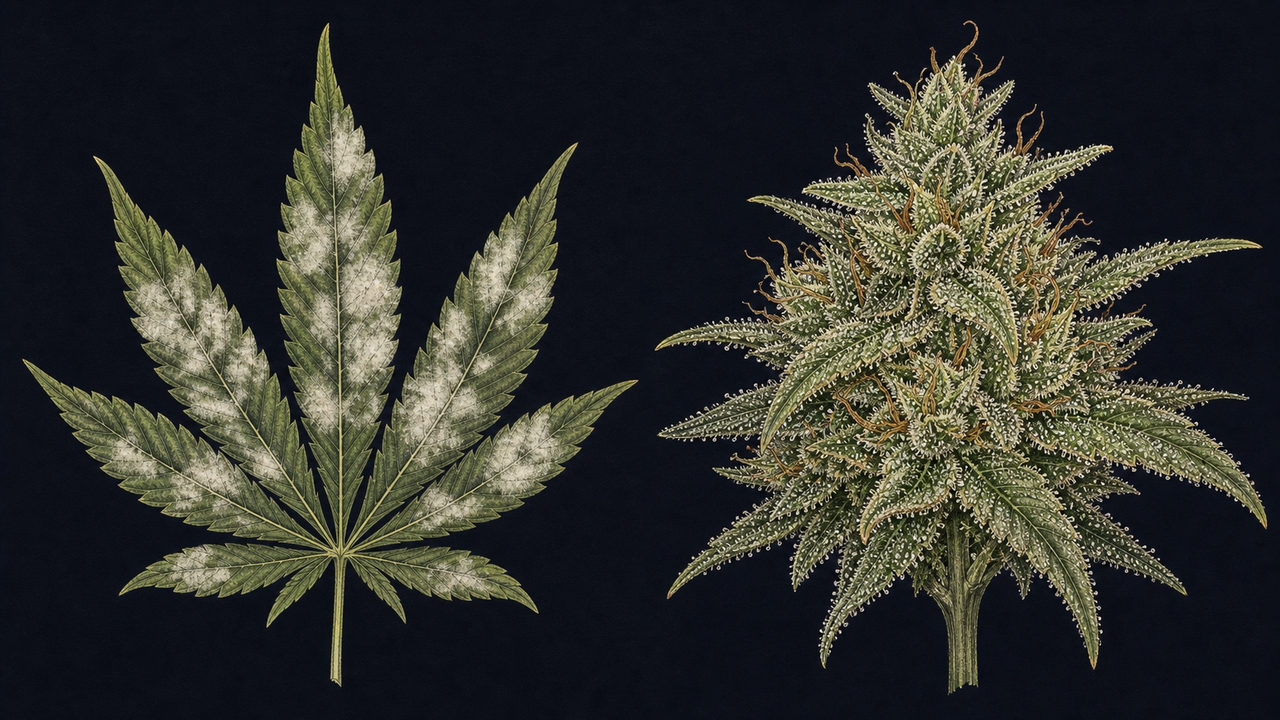
This comparison matters because the error goes in both directions - growers see PM and think “good frost,” and they sometimes see heavy trichome coverage and worry it’s disease.
| Feature | Powdery Mildew | Trichomes |
|---|---|---|
| Texture | Fuzzy, powdery, matte | Crystalline, glittery |
| Color | White to gray (can look dirty) | Translucent to milky white |
| Touch test | Transfers to finger, feels dusty | Sticky, doesn’t transfer |
| Wipe test | Wipes off as powder | Firmly attached |
| Shape | Irregular patches with fuzzy edges | Distinct mushroom stalks (under magnification) |
| Location | Any leaf surface, starts on older lower leaves | Concentrated on flowers and sugar leaves |
| Distribution | Random colonies expanding outward | Uniform coating across surface |
| Smell | Musty in advanced infection | Resinous, aromatic |
Three Tests to Confirm
Touch test. Lightly rub the white area with your finger. PM transfers as a dusty powder. Trichomes are sticky and stay on the plant.
Wipe test. Try to wipe the coating with a cloth. PM wipes off cleanly. Trichomes remain attached.
Magnification (10x loupe). Under magnification, trichomes show distinct mushroom-shaped heads on uniform stalks. PM looks like fuzzy, irregular filaments with no consistent structure.
If you’re unsure after all three tests, assume it’s PM and treat accordingly. The cost of a false positive - treating a healthy plant - is much lower than the cost of a false negative.
Distinguishing From Other Conditions
Powdery Mildew vs. Bud Rot (Botrytis)
Both can appear during flowering, but they start in different places and look different up close.
- PM: Starts on leaf surfaces as white powder, spreads outward
- Bud rot: Starts inside dense bud tissue as gray-brown mold, spreads inward
- PM: Dry, wipes off as powder
- Bud rot: Slimy, penetrates tissue, leaves mushy gray-brown areas when probed
Powdery Mildew vs. Spider Mite Webbing
Heavy spider mite webbing can be confused with PM in advanced stages.
- PM: Powdery coating directly on leaf surfaces, no web structure
- Webbing: Actual filamentous strands connecting leaves and stems, visible as a network with tiny mites present
- PM: Surface phenomenon on the leaf
- Webbing: Spans between plant structures
Powdery Mildew vs. Fertilizer Residue
Spray residue and fertilizer salt deposits are a common false positive.
- PM: Fuzzy texture, grows and expands over days
- Residue: Crystalline, stays fixed, doesn’t spread
- PM: Circular colonies from infection points
- Residue: Irregular splatter pattern matching where spray landed
Treatment and Prevention
If You’ve Found It: Immediate Steps
Isolate the infected plant. Remove it from the grow space carefully - don’t shake the leaves, which disperses spores.
Remove heavily infected leaves. Seal them in a bag before removal. Dispose of, don’t compost.
Increase airflow immediately. Run oscillating fans, check that exhaust is adequate.
Apply treatment to the infected plant and all immediate neighbors:
- Potassium bicarbonate spray (effective at any stage, flower-safe)
- Copper-based fungicides (veg stage only)
- Neem oil (veg stage only - off-gasses problematically in flower)
- Commercial PM treatments labeled as flower-safe for late-stage infections
Inspect every other plant in the grow. Assume airborne spread has already occurred. Look for early colonies on older lower leaves of adjacent plants.
Prevention
Environmental control (most effective):
- Maintain humidity below 60%, below 45% in late flower
- Install oscillating fans for continuous air movement
- Prevent leaf-on-leaf contact through spacing and selective defoliation
- Maintain stable temperature - fluctuations create favorable infection windows
- Consider HEPA filtration between grow cycles to reduce ambient spore load
Cultural practices:
- Inspect plants daily, particularly lower leaves and poor-airflow corners
- Quarantine any new plant material for at least two weeks before introducing to your grow
- Sterilize tools between plants
- Remove dead leaves promptly - they create moisture pockets
Preventive treatments (before symptoms appear):
- UV-C light treatment between grow cycles kills residual spores
- Preventive potassium bicarbonate or copper sprays provide significantly better protection than reactive treatment after symptoms appear
- IPM programs that address PM as a standing preventive protocol, not a reactive one
How AI Detection Works
Powdery mildew is fundamentally a texture classification problem - distinguishing the powdery, irregular surface of PM colonies from the crystalline structure of trichomes and the smooth surface of healthy leaf tissue.
PlantLab’s model analyzes:
- Color contrast: White patches against green leaf tissue create a high-contrast signal the model identifies reliably
- Texture signature: PM colonies have a granular, matte surface texture measurably distinct from trichomes (crystalline) and healthy leaf (smooth with natural sheen)
- Colony geometry: PM grows in circular patterns from infection points with fuzzy, irregular edges - different from the uniform distribution of trichome coverage
- Location context: Where on the plant the pattern appears matters; PM preferentially affects older, lower leaves in early infection
Early-stage detection - colonies as small as 5mm - catches infection when treatment options are broadest. Automated daily scanning catches what manual inspection misses when you’re managing more than a few plants.
Try it free at plantlab.ai - 3 diagnoses per day, no credit card required.
FAQ
Can I smoke buds with powdery mildew? No. PM spores and fungal material can cause respiratory issues, particularly for anyone with lung conditions or compromised immunity. Infected flower should be disposed of, not consumed.
Does powdery mildew spread to other plants? Yes, rapidly. Airborne spores can reach every plant in a contained grow space within 5-10 days under favorable conditions. Isolate infected plants immediately and inspect everything nearby.
Can plants recover from powdery mildew? Mildly infected plants can survive and produce with aggressive treatment, but affected tissue doesn’t recover. The goal is to stop the spread. Heavily infected plants in late flowering are usually a loss.
Does lowering humidity kill powdery mildew? It inhibits new infection but doesn’t eliminate established colonies. PM can remain active even below 50% relative humidity once established. Humidity reduction is a prevention tool, not a cure for active infection.
When is powdery mildew most likely to appear? Typically around two weeks into flowering, when dense bud sites create microclimates with trapped humidity and reduced airflow. It can appear at any life stage given favorable conditions, but flowering onset is the highest-risk window.
PlantLab’s AI detects 30 cannabis conditions - including powdery mildew, bud rot, and 7 specific nutrient deficiencies. Start diagnosing free at plantlab.ai.
Related reading
- Bud Rot and Root Rot in Cannabis: Detection Before It’s Too Late - the other fungal threat that thrives in the same trapped humidity
- Spider Mites on Cannabis: Early Detection Before the Damage - the pest that shares PM’s still-air, low-airflow risk pockets
- Build an Autonomous Plant Health Monitor with Node-RED - automate a daily photo check so PM gets caught at first spots
- What’s Wrong With My Cannabis Plant? A Visual Diagnosis Guide - the full symptom-to-cause quick reference