Calcium vs Magnesium Deficiency in Cannabis: A Visual Comparison
Something's wrong with your plant. The leaves look off. You post a photo to a growing forum and within minutes, three people reply: “CalMag.”
You could have posted a picture of your dog and someone would have said CalMag.
It's the universal answer to every cannabis problem, the “have you tried turning it off and on again” of indoor growing. Yellowing? CalMag. Spots? CalMag. Weird leaf curl? Believe it or not, CalMag. And hey – sometimes it works. But when it doesn't, most growers just add more CalMag, which can make things actively worse.
Here's the thing nobody on the forums tells you: calcium and magnesium are two different nutrients that cause two different problems in two different places on the plant. Dumping a combined supplement at every symptom is like taking both Advil and Tylenol every time anything hurts – sometimes you need one, sometimes the other, and sometimes the extra dose of the wrong one creates a new problem.
This guide breaks down what calcium deficiency actually looks like versus magnesium deficiency, where to find each one on your plant, and how to stop guessing.
Quick Identification
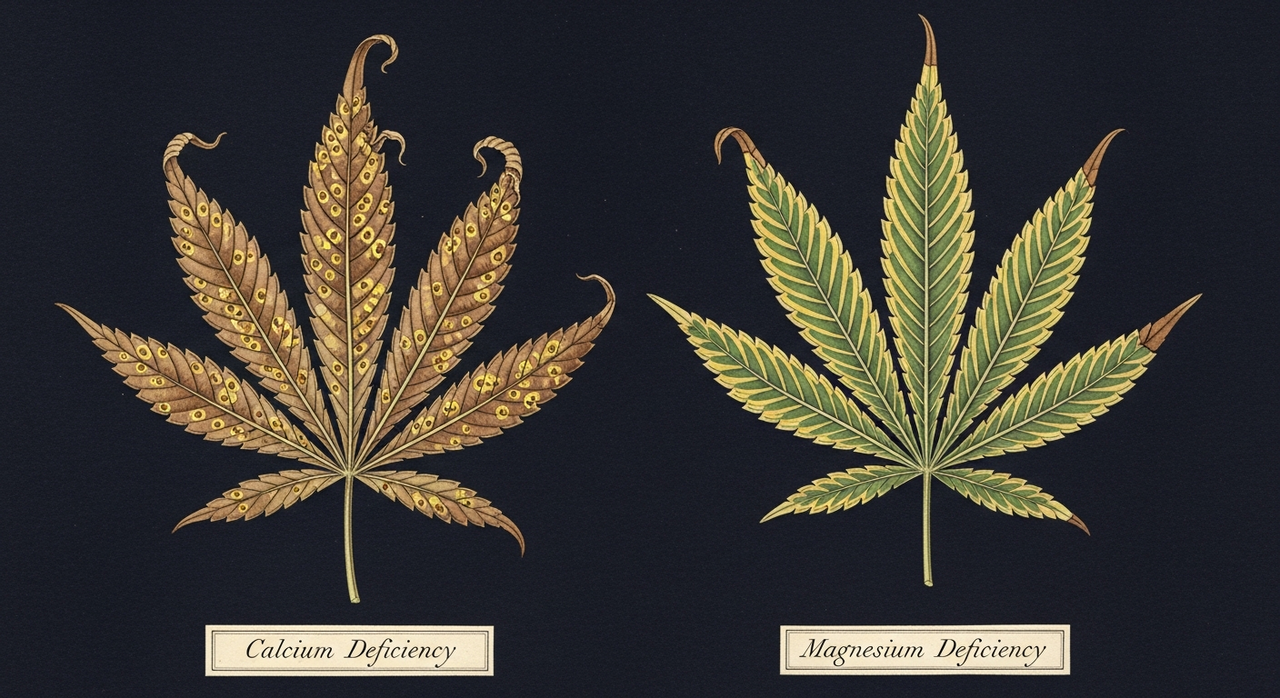
Calcium deficiency produces irregular brown spots and necrotic patches on newer, upper growth. Magnesium deficiency produces interveinal yellowing – green veins with yellow tissue between them – on older, lower leaves.
The single most useful diagnostic: location on the plant. Calcium can't move once the plant deposits it in cell walls, so when supply runs short, it's the newest growth that suffers first. Magnesium is mobile – the plant pulls it from old leaves to feed new ones, so the oldest leaves show damage first.
Lower leaves yellowing between the veins? Magnesium. Upper leaves developing brown dead spots? Calcium. Or Calcium = High, Magnesium = Low, if you want it super simple.
Why They Get Confused
Blame the Bottle
The supplement industry packages calcium and magnesium together because both are secondary macronutrients that RO and filtered water strips out. As a preventive baseline, that's fine. As a diagnostic tool, it's useless.
When a grower sees something wrong and reaches for the CalMag, one of three things happens:
- The plant needed magnesium. The CalMag contains magnesium, so it helps. The grower walks away thinking “CalMag works” without learning anything.
- The plant needed calcium. Same thing.
- The plant needed one but not the other. This is where it gets ugly. Calcium and magnesium are both cations that compete for the same uptake sites on roots. Adding an excess of the one your plant didn't need starts blocking the one it did.
That third scenario is why “I added CalMag and it got worse” is a meme for a reason. It's not that CalMag is bad – it's that using it as a diagnostic shortcut can create the exact antagonistic lockout you were trying to fix.
The Photo Problem
Both deficiencies can produce yellowing. Both can cause spots. A photo of a calcium-deficient upper leaf and a magnesium-deficient lower leaf can look surprisingly similar without context. And context – which part of the plant, which leaves, what pattern – is exactly what gets lost in a blurry photo posted at odd hours.
Visual Symptoms: Side by Side
Calcium Deficiency
Shows up on new growth at the top of the plant – upper leaves, growing tips, youngest tissue.
What you'll see: – Irregular brown or tan spots that seem to appear overnight – The spots feel crispy and dead, not soft or yellow – New leaves coming in distorted, curled, or crinkled – Growing tips stunting or dying back – Stems developing weak, hollow sections in bad cases – Spots that don't follow any vein pattern – they just show up randomly
How it progresses: 1. Small brown spots appear on young leaves 2. Spots expand and merge into larger dead patches 3. Leaf edges curl inward and brown 4. Growing tips stunt or die 5. Stems weaken – the plant gets structurally fragile
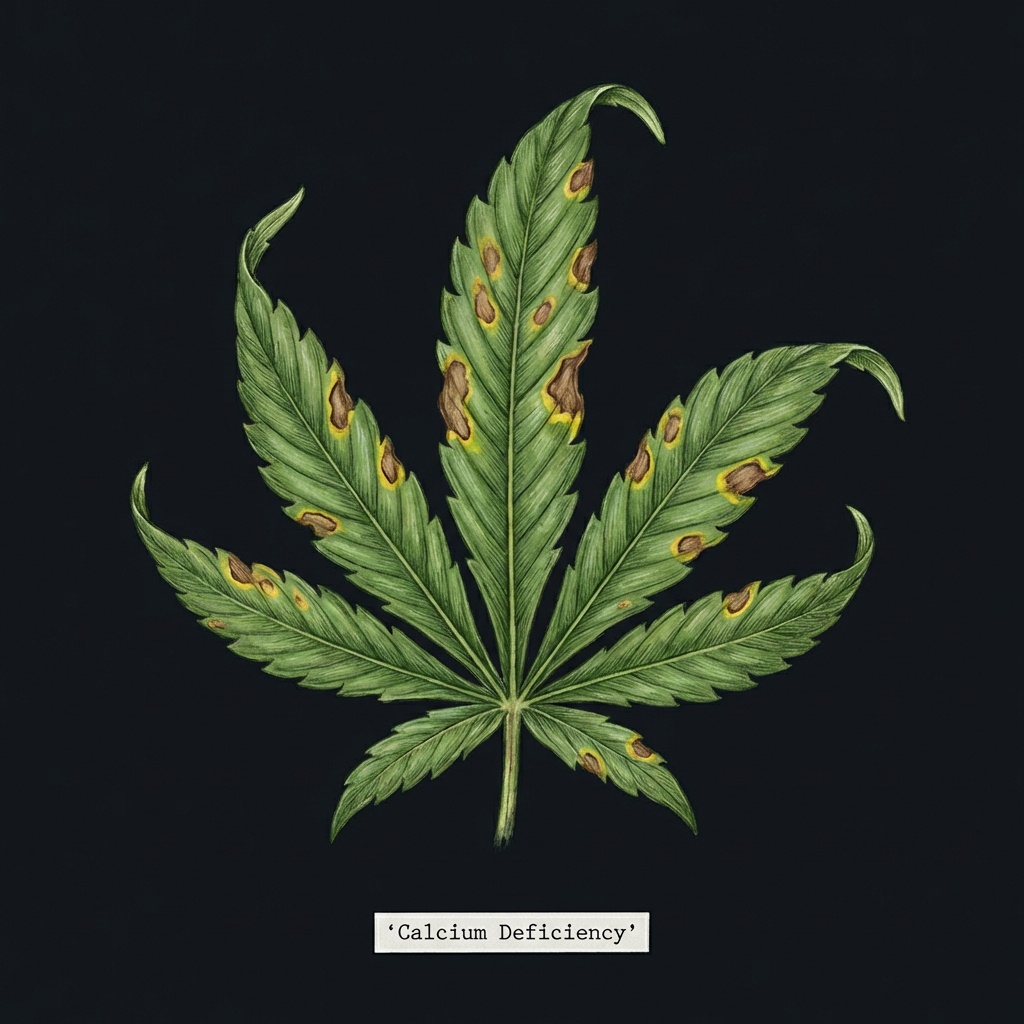
The quick test: If you can crumble the affected tissue between your fingers, and the damage is on the top of the plant, calcium deficiency is your most likely suspect.
Magnesium Deficiency
Shows up on older growth at the bottom of the plant – lower leaves, middle canopy, the oldest tissue first.
What you'll see: – Yellowing between leaf veins while the veins themselves stay green (interveinal chlorosis) – Starts at the leaf edges and creeps inward toward the midrib – The classic “tiger stripe” pattern on fan leaves – Older leaves eventually going fully yellow, then brown, then dropping off – Veins staying distinctly green throughout – this is what separates it from nitrogen deficiency
How it progresses: 1. Lower leaf margins start yellowing 2. Yellowing spreads between veins, creating that green-vein / yellow-tissue contrast 3. Edges go brown and necrotic 4. Leaves curl upward slightly 5. Worst-hit leaves drop
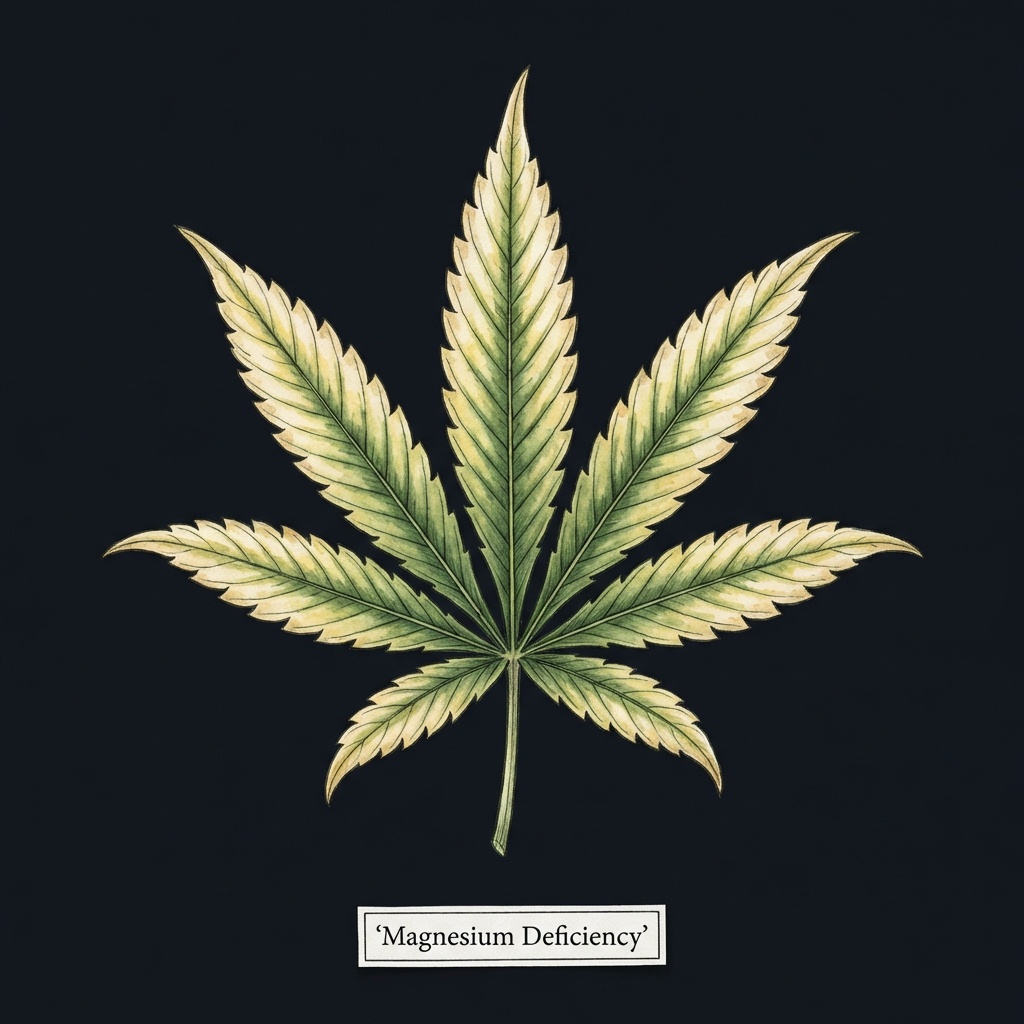
The quick test: Green veins with yellow tissue between them, starting from the bottom of the plant. If the veins are yellowing too, that's nitrogen, not magnesium.
The Comparison Table
| Feature | Calcium Deficiency | Magnesium Deficiency |
|---|---|---|
| Affected leaves | New growth (top) | Old growth (bottom) |
| Mobility | Immobile – stays where deposited | Mobile – plant moves it to new growth |
| Primary symptom | Brown necrotic spots | Interveinal yellowing |
| Vein color | Veins unaffected | Veins stay green while tissue yellows |
| Spot texture | Crispy, dry, crumbles | Soft yellowing, papery when advanced |
| Pattern | Random irregular spots | Symmetric between veins |
| Edge symptoms | Curling, browning of new leaf edges | Browning of old leaf edges (late stage) |
| Progression direction | Top down | Bottom up |
| Stem effects | Weak, hollow stems possible | None |
| Speed of onset | Fast (days) | Gradual (1-2 weeks) |
What Else It Could Be
Calcium and magnesium each have their own lookalikes. Getting these wrong sends you down the wrong treatment path.
Calcium vs Potassium
Both produce brown, crispy leaf edges. Calcium does it on new growth with irregularly placed spots. Potassium does it on older leaves with a defined burned-edge pattern that starts at tips and margins and works inward. If the crispy edges are at the bottom of the plant, think potassium before calcium.
Magnesium vs Nitrogen
Both cause yellowing on older leaves. The tell is the veins. Magnesium keeps the veins green – the yellowing is only between them. Nitrogen yellows the entire leaf uniformly, veins and all. No interveinal pattern means nitrogen, not magnesium.
Magnesium vs Iron
Both cause interveinal chlorosis. Same pattern, opposite location. Magnesium hits old leaves at the bottom (mobile nutrient moving to new growth). Iron hits new leaves at the top (immobile nutrient that can't be redistributed). If the interveinal yellowing is at the top of the plant, it's iron. Bottom, magnesium. This one is actually definitive.
Common Causes
Why Calcium Runs Low
Reverse osmosis or filtered water. Tap water naturally contains calcium. RO strips it. If you switched to RO without adding calcium back, this is probably your answer.
Low pH. Below pH 6.0 in soil, calcium is still physically present but chemically locked out. You can add all the calcium you want – the plant can't access it.
Excessive potassium or ammonium. Both compete with calcium for root uptake. Those high-K bloom feeds? They can induce calcium deficiency even when there's plenty of calcium in the medium.
High humidity. Calcium moves through the plant via transpiration. In very humid environments, transpiration slows, and calcium stops reaching the growing tips. This is the one that catches experienced growers off guard – everything else looks perfect but the new growth keeps getting spots.
Why Magnesium Runs Low
Coco coir. The single most common cause in modern indoor growing. Coco has a natural affinity for calcium and magnesium cations – it holds onto them rather than releasing them to roots. If you grow in coco and don't buffer for this, magnesium deficiency is basically guaranteed.
Too much calcium supplementation. Ironic, right? Excess calcium blocks magnesium at root exchange sites. The fix for one deficiency can cause the other. This antagonistic relationship is why “just add CalMag” is sometimes exactly the wrong move.
Low pH. Same as calcium – availability drops below pH 6.0.
Intense LED lighting. LEDs drive more photosynthesis per watt than HPS, and magnesium is the central atom in every chlorophyll molecule. More light means more chlorophyll demand means more magnesium consumption. Growers who switch from HPS to LED at the same feed rate often see magnesium deficiency appear within two to three weeks. It's not the lights causing the problem – they're just exposing a margin that was previously fine.
Treatment
Fixing Calcium Deficiency
Check pH first. If your root zone is below 6.0, no amount of calcium will help – it's locked out. Correct to 6.0-6.5 (soil) or 5.8-6.0 (hydro/coco) before you add anything.
Use a calcium-specific supplement. Calcium nitrate provides calcium without adding magnesium. This matters when your magnesium levels are fine and you don't want to throw off the ratio.
Dolomite lime for soil. Slow-release calcium and magnesium. Better as a preventive amendment mixed in at planting than as a mid-grow rescue.
Look at competing cations. Running a heavy bloom feed with high potassium? The K might be the reason calcium can't get through. Temporarily dial it back.
New growth should improve within 5-7 days. The damaged leaves won't recover – don't wait for them to. Watch the new growth above the damage zone instead.
Fixing Magnesium Deficiency
Check pH first. Same story – lockout before deficiency.
Epsom salt. 1-2 teaspoons per gallon of water. Magnesium sulfate is the fastest targeted fix and it's cheap. Your plant doesn't care that it came from a $3 bag at the pharmacy.
Foliar spray for speed. 1 teaspoon Epsom salt per litre of water, sprayed directly on affected leaves. Foliar absorption bypasses whatever root problem is blocking uptake. Useful as a quick fix while you sort out the root zone.
Reduce calcium if you over-supplemented. If you've been heavy on CalMag or calcium nitrate, the excess calcium may be the reason magnesium can't get through. Sometimes the treatment is subtraction, not addition.
Foliar spray shows results in 3-5 days. Root-zone correction takes 7-10 days. Same as calcium – old leaves won't recover, but the damage should stop spreading and new growth should come in clean.
Prevention
Test your water. Know your baseline calcium and magnesium before adding anything. Tap water in many regions provides enough of both. If you're on tap water and getting deficiency symptoms, the problem is almost certainly pH or antagonism, not supply.
Manage your pH. Root zone between 6.0-6.5 (soil) or 5.8-6.0 (hydro/coco). This single practice prevents more deficiencies than every supplement combined.
Match your medium. Coco growers need more CalMag than soil growers. LED growers need more magnesium than HPS growers. Generic feeding charts are written for average conditions – adjust for your actual setup.
Watch the ratio. Optimal Ca:Mg is 3:1 to 5:1. When this drifts – usually from over-supplementing one side – the other becomes deficient through antagonism, not absence. You can cause a deficiency by adding too much of the other nutrient. That's the cruel joke of cation chemistry.
How AI Detection Works
This confusion between calcium and magnesium is a pattern recognition problem at its core. The symptoms are visually distinct – brown spots versus interveinal yellowing, top versus bottom – but at 2 AM, staring at a phone photo of a leaf under a blurple light, those distinctions get fuzzy. The human answer to “CalMag or not?” has always been “post a photo and hope someone experienced is online.”
PlantLab is built for exactly that call. When the model flags a nutrient issue it doesn't stop at a generic “nutrient deficiency” label – it names the specific deficiency, calcium and magnesium included, and attaches a calibrated confidence score so you know how sure it is. On the genuinely ambiguous shots – overlapping symptoms, bad lighting, the ones growers argue about in the comments – that confidence number is the honest part. A lower score is the model telling you to slow down and check pH, not a false guarantee.
One photo. A specific suspect with a confidence level attached – calcium or magnesium, not a reflexive “CalMag.” You still make the final call, but you start from the right suspect instead of the forum's favorite.
Try it free at plantlab.ai – three diagnoses per day, no credit card.
FAQ
Can a plant have both calcium and magnesium deficiency at the same time?
Yes, and it's common with RO water or unbuffered coco. You'll see interveinal yellowing on lower leaves (magnesium) and brown spots on upper leaves (calcium) at the same time. This is the one scenario where reaching for the CalMag bottle is genuinely the right call. Confirm with pH testing first – if pH is the root cause, a single correction may fix both.
Is CalMag ever the right answer?
For prevention, absolutely. As a baseline addition to RO water or coco grows, CalMag works well. The problem is using it as a diagnostic reflex – adding it before you've figured out which nutrient is actually short. If only one is deficient, a targeted supplement avoids throwing off the ratio of the one that was fine.
Why do LED growers see more magnesium issues?
Magnesium is the central atom in chlorophyll. LEDs drive more photosynthesis per watt than HPS, which means more chlorophyll turnover, which means higher magnesium demand. Growers who switch to LEDs at the same feed rate they used under HPS often see magnesium deficiency show up within weeks. The plant was fine before because it wasn't photosynthesizing as hard.
How long before I see improvement after treatment?
Foliar magnesium spray: 3-5 days. Root-zone magnesium correction: 7-10 days. Calcium (new growth): 5-7 days. In every case, the old damaged leaves are done – they won't green back up. Watch the new growth above the damage.
Can pH lockout cause both deficiencies at once?
Yes. Both calcium and magnesium availability drops sharply below pH 6.0. A single pH correction can resolve what looks like a dual deficiency without adding any supplements at all. This is why “check pH first” appears in every treatment section above. It's boring advice, but it's boring because it works.
Related Reading
- Potassium Deficiency in Cannabis – the third “burnt edges” mimic, and how its rust-flecked margins differ from calcium's random spotting
- Nitrogen Deficiency in Cannabis – the uniform bottom-leaf yellowing that magnesium's green-vein pattern gets mistaken for
- Nutrient Antagonism: When Feeding More Makes It Worse – the cation-competition chemistry behind “I added CalMag and it got worse”
- What's Wrong With My Cannabis Plant? – the full visual diagnosis guide covering every common deficiency