Removing an infected tomato crop does not end the cost of an outbreak. The business still has to pay for disposal and cleanup, establish replacement plants, and fund the gap before harvest resumes.
One UK case makes that gap concrete. An AHDB report describes a 6.5-hectare tomato block where early crop removal meant 11 weeks of lost production. Across the three businesses studied, growers kept experienced staff even when there was little work. Wages and other overheads continued before fruit sales returned. AHDB/ADAS, November 2020, pages 6–8.
These cases concern tomato brown rugose fruit virus, or ToBRFV. They offer evidence about commercial greenhouse losses, not a universal price for an outbreak. Their costs cannot be transferred directly to Botrytis or another disease.
Read more...
Brown spots on tomato leaves can come from early blight, Septoria leaf spot, bacterial disease, or another cause. Rings, pale centers, and marks on fruit help narrow the possibilities. One new spot rarely settles the answer.
Start with the whole plant. Note whether the oldest leaves are affected first, whether new growth looks normal, and whether nearby plants show the same damage. Then look closely at several spots, including older ones.
Read more...
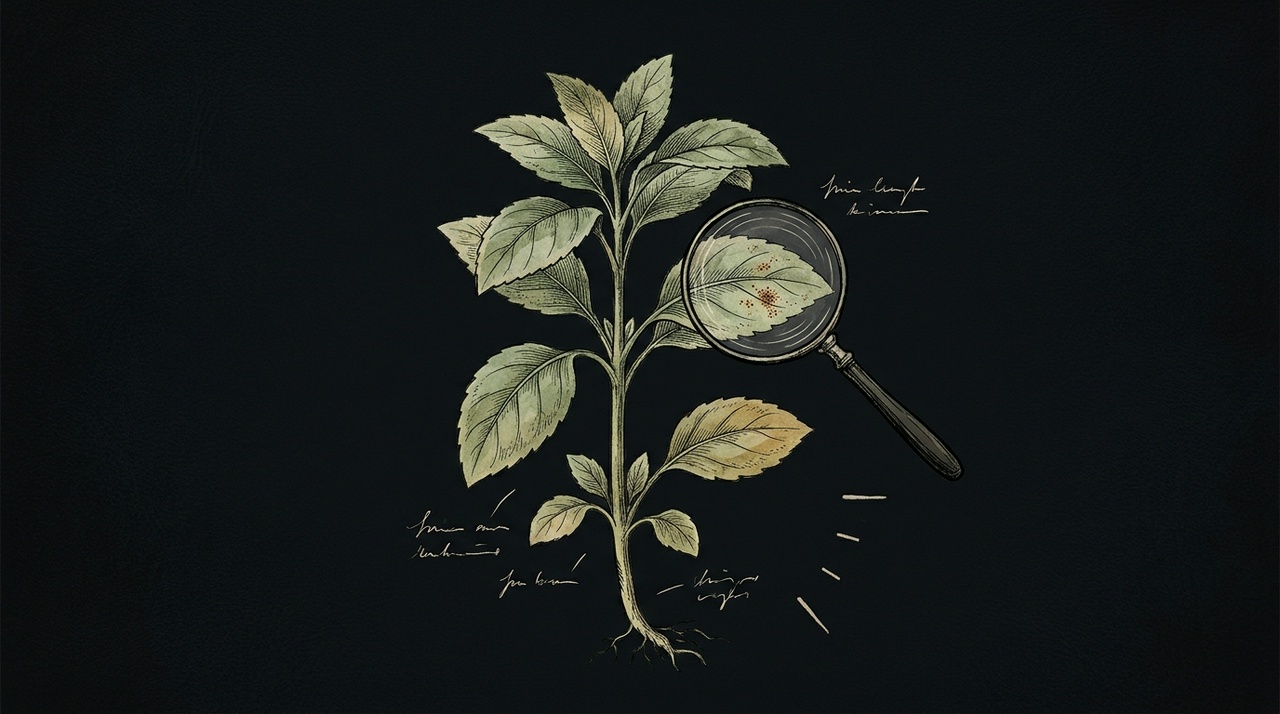
Turn the leaf over. Pale yellow patches on the upper side of a greenhouse tomato leaf tell only part of the story. Olive-brown, velvety growth beneath those patches makes tomato leaf mold a possibility worth investigating.
Leaf mold often starts on older leaves. It is associated with greenhouse and high-tunnel production, where humid conditions favor disease. The University of Minnesota leaf mold guide includes photographs of both leaf surfaces.
Read more...
A tomato leaf can curl because of growing conditions, insect feeding, herbicide injury, or a virus. The first useful distinction is whether established leaves roll inward or new growth becomes distorted. Curl alone cannot identify the cause.
Before removing leaves or adding fertilizer, compare the affected plant with a nearby plant of the same variety. Look at the newest leaves, the lower leaves, and the fruit. Record what differs.
Read more...
If a chat assistant or an agent already runs part of your workflow, you can ask it to look at a plant photo and say what is wrong. The assistant can answer from the photo alone. With the PlantLab MCP server, it sends the photo to PlantLab instead. The diagnosis then comes from PlantLab’s model, with its confidence score.
The server is optional. If you can call an API from your own code, the API is still the cleaner and more direct route. The MCP server is for people who want the assistant itself to call PlantLab.
Read more...
PlantLab started a little over a year ago, in October 2025, and went public that December. This post is a status report: what the system does today, which parts I trust, and which parts I do not.
Read more...
Yellow leaves, brown spots, and drooping stems can point to different tomato problems. Start with four clues: which leaves changed first, what the damage looks like, how fast it spread, and whether the soil is wet or dry. Then check the leaves, stems, and fruit for more evidence.
Read more...
PlantLab’s plant health diagnosis API accepts a plant photo and returns structured JSON. A garden app can display the result. A greenhouse system can attach it to an observation record. An AI agent can read the same contract before it sends a request.
Tomato and cannabis diagnosis are available, with different coverage and fields. This example uses tomato and schema version 4.1.0.
Read more...
An AI plant health check suggests possible problems from a photo. Read its answer alongside the plant, its recent history, and the tool’s supported diagnoses. A confidence figure is useful context, but it does not prove the cause.
Read more...
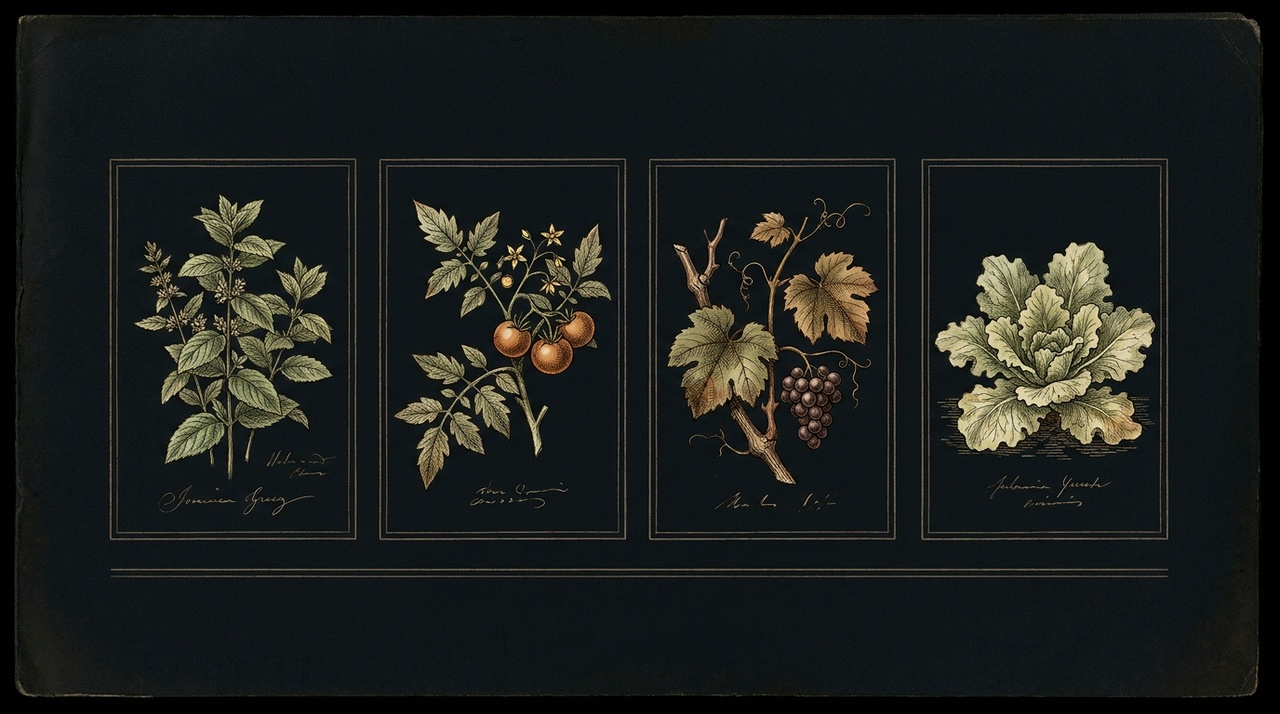
PlantLab had its name from day one, and the name was the plan: a diagnosis lab for plants, all of them, eventually. Tomato and cannabis diagnosis are available today. Apple, grape, and leafy greens are planned. The long game is a lab that carries what it learns from one crop into the next.
Read more...
Tomato diagnosis is available in PlantLab. This post began as a September 2026 announcement that tomato was the next crop. This October update replaces that earlier roadmap status with what you can use today.
Read more...
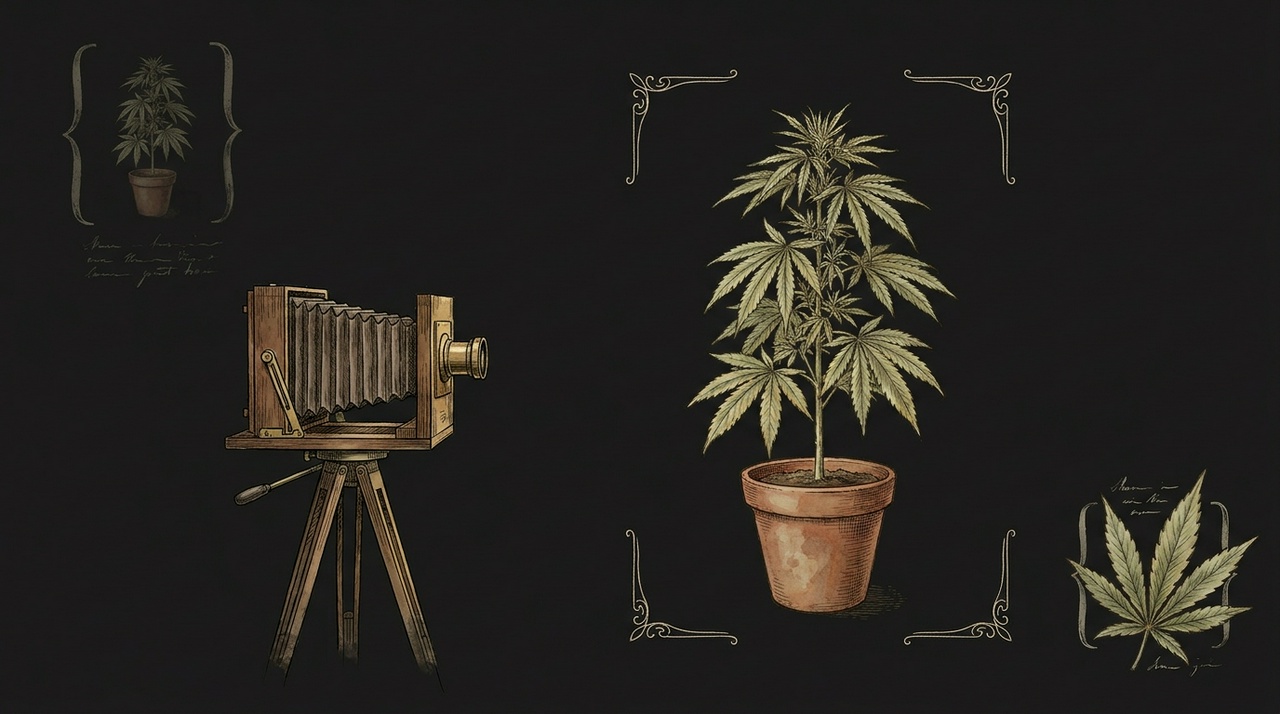
How to Photograph a Cannabis Plant for Diagnosis Frame the whole plant so it fills most of the shot, and use even light that isn’t blown out. Don’t zoom in on the damaged leaf, and don’t shoot from across the tent. If your lights are blurple, that matters far less than whether the photo is overexposed.
The mistakes that cost you most aren’t the ones people expect.
Read more...
This article includes historical API examples. Read the current API documentation for supported plants and fields.
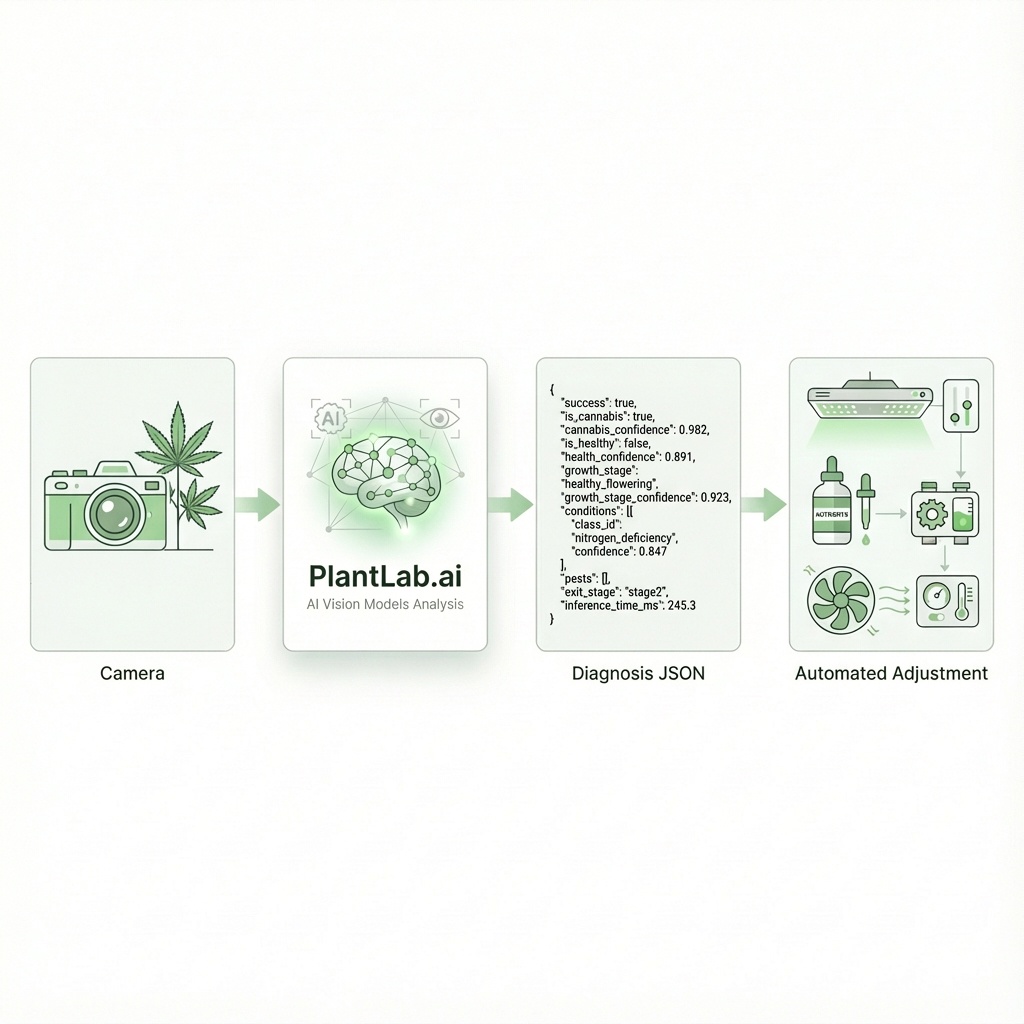
What It Does The PlantLab API takes one image of a cannabis plant and returns structured JSON describing what’s wrong with it: one of 30 conditions and pests (or healthy), a growth stage, a confidence score on every call it makes, and a bounding box per plant when the photo has more than one. Auth is a single X-API-Key header, and the free tier is 3 diagnoses a day without a card.
If you already have a camera pointed at your tent, this is the piece that turns a JPEG into something your automation can branch on.
Read more...
This article includes historical API examples. Read the current API documentation for supported plants and fields.
The Short Version Between June and August 2026, PlantLab learned to diagnose several plants in one photo, started naming the family of a condition when it isn’t sure of the specific name, made model upgrades visible to your code, and fixed an upload failure that took three tries to actually kill.
The middle two change what comes back in your JSON.
Read more...
Every time you water, a little cloud of dark flies lifts off the soil, drifts around, and settles back down. They do not bite, they do not swarm the plant, and every forum thread calls them harmless. So you ignore them.
Meanwhile the plant is drooping. Lower leaves are yellowing, growth has slowed, and nothing about your feed or pH explains it. You start treating for overwatering, maybe root rot - and the real cause is still hovering over the pot.
Read more...
Thrips can leave silver or bronze scars on cannabis leaves, often with tiny black droppings beside the damage. Look for slender insects on both sides of the leaf. Silvering alone does not confirm thrips.
Use the comparison below to separate thrips damage from spider mites and light burn. If the symptoms do not match, start with the plant symptom guide.
Read more...
You backed off the feed. The runoff numbers looked high, the tips looked crispy, so you did what every guide says to do when a plant looks overfed: you gave it less. A week later the leaf edges are worse - browner, drier, curling up like burnt paper.
That is the trap with potassium. The classic symptom, scorched leaf margins, looks exactly like the thing you would treat by feeding less. But a potassium-deficient plant is starving, not overfed, and cutting the feed pushes it further down.
Read more...
This article includes historical API examples. Read the current API documentation for supported plants and fields.
What You’ll Build A camera watches your plants on a schedule. Each photo goes to PlantLab for a supported-plant diagnosis, and Home Assistant turns the answer into sensors you can automate against. Something looks off, your phone buzzes with the diagnosis and the photo. Everything’s fine, it stays quiet.
Setup runs about 20 minutes. The cost is a camera you probably already own plus PlantLab’s free tier - three diagnoses a day, no card. No soldering, no standalone Python scripts. A Home Assistant integration and some YAML.
Read more...
This article includes historical API examples. Read the current API documentation for supported plants and fields.
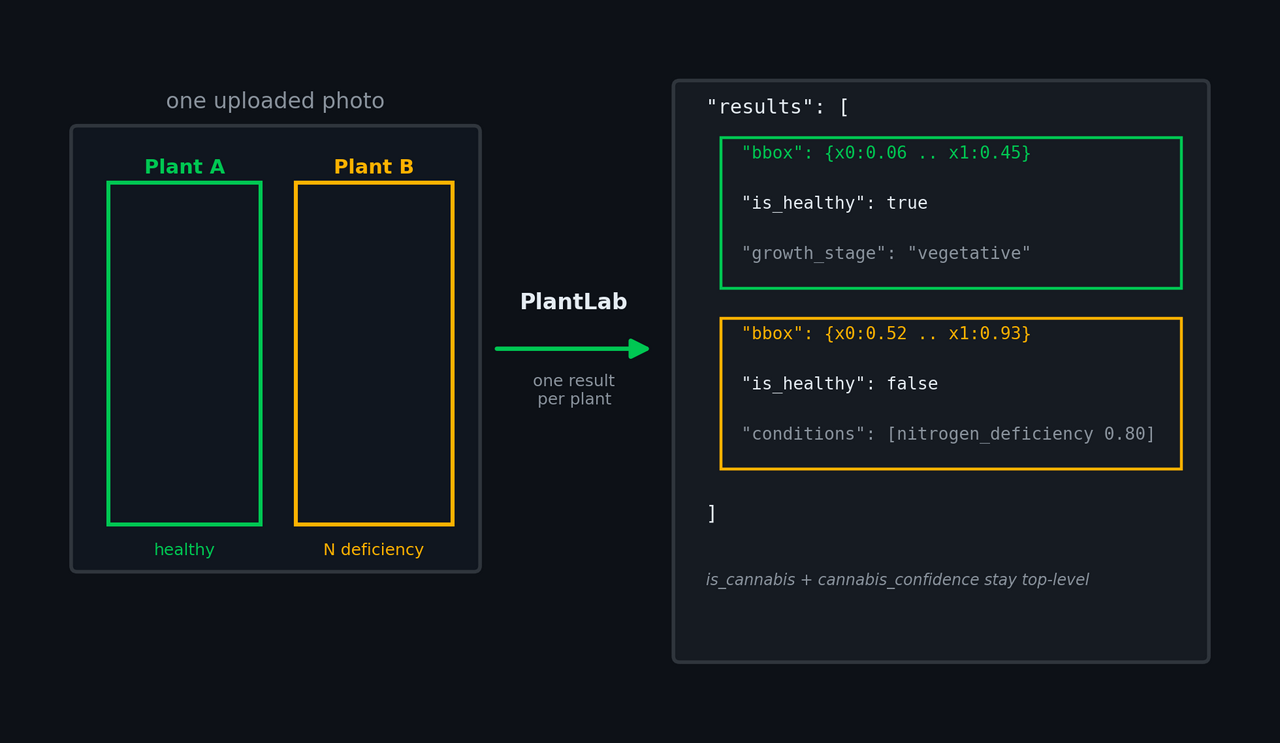
The short version PlantLab can now analyze more than one plant in a single uploaded photo. Instead of forcing the whole image into one diagnosis, the API finds the separable plants, diagnoses each one on its own, and returns a results[] array with one entry per plant.
This is a breaking API change. The response schema is now 3.0.0. Fields like is_healthy, growth_stage, conditions, pests, and reliability_score moved out of the top level and into results[]. Image-level fields such as is_cannabis and cannabis_confidence stay top-level.
If your code already treats a diagnosis as “the answer for this plant,” the migration is simple: iterate results[]. Single-plant photos still return exactly one result.
Read more...
A plant-health result gives you a starting point for inspection. It does not establish every cause from a photo. Similar symptoms can come from different problems, and a confident result can still be wrong.
Read more...
This article includes historical API examples. Read the current API documentation for supported plants and fields.
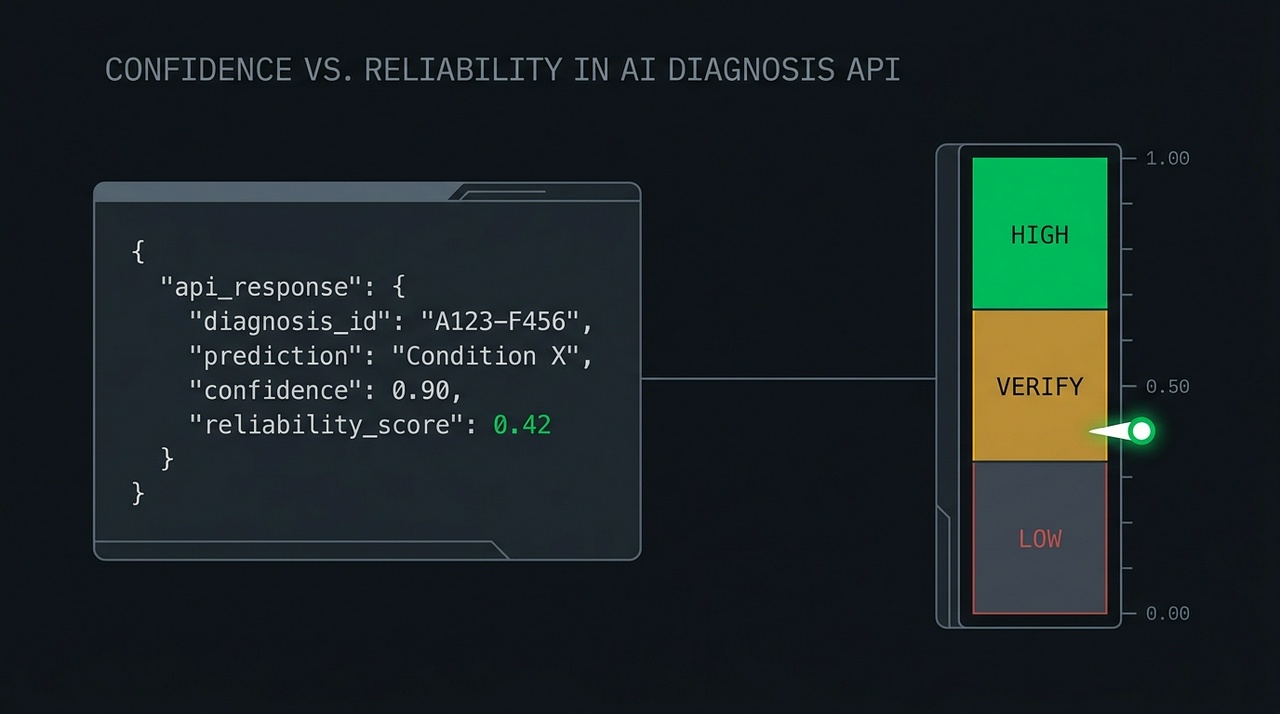
Confidence and reliability answer different questions A diagnosis can have high confidence and still be wrong. A photo can hide symptoms, show several problems, or resemble more than one condition.
Per-condition confidence describes the strength of a particular prediction. reliability_score is a separate estimate of the reliability of a plant result. Neither value confirms the cause of a plant problem.
Read more...
Building on American cloud is the easy choice, which is exactly why almost everyone makes it. One account at Amazon, Google, or Microsoft and you get the whole stack in one place: compute, database, storage, DNS, email, all of it wired together, billed on one invoice, documented to death. It is a genuinely excellent product. It is also where PlantLab started.
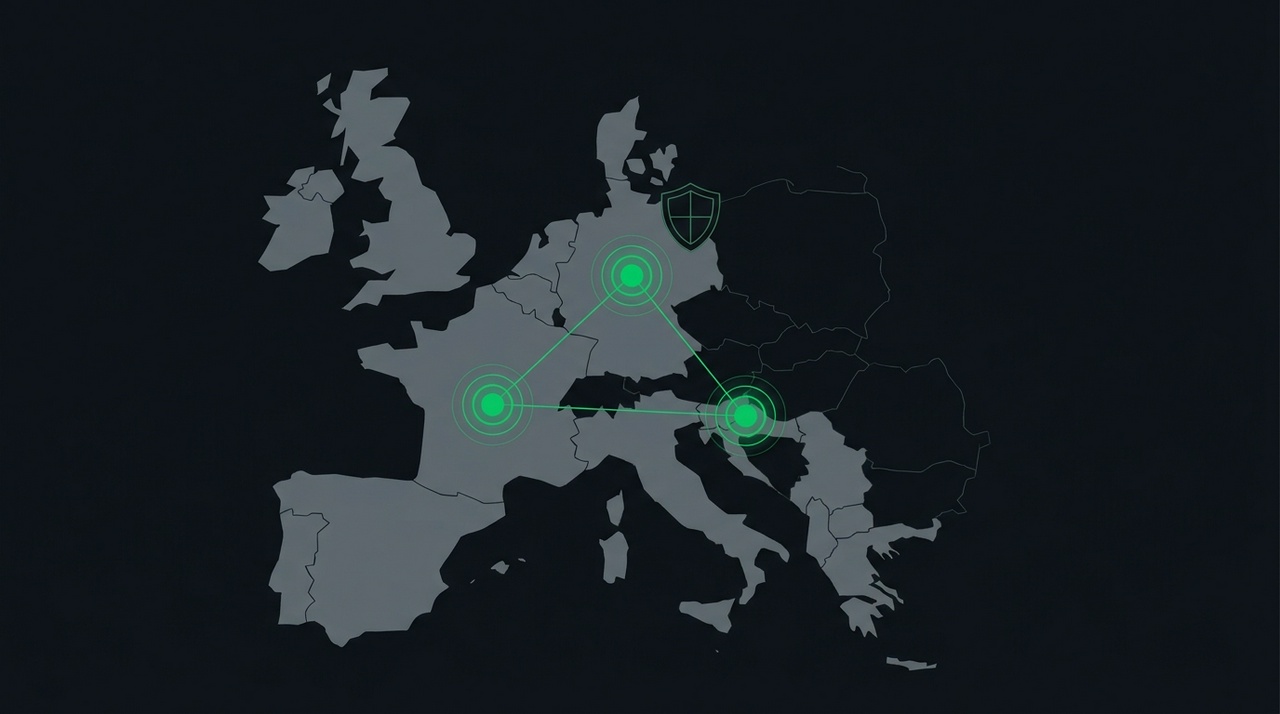
It doesn’t run there anymore. The diagnosis API, the database that holds your history, and the services around them now run on European infrastructure, and the live path a request travels - upload, inference, response, storage - never leaves the EU. That was not the easy choice. I want to explain why I think the easy choice and the right one were two different things here.
Read more...
The Short Version I spent two days in May chairing and speaking at World Class Cannabis Business Europe (WCCBE) in Frankfurt, on the subject of visual AI for cannabis cultivation. The biggest takeaway wasn’t about the technology. It was about the gap between what the AI industry likes to talk about - autonomy, end-to-end automation, “AI runs the grow” - and what growers in the room actually asked for, which was something much more grounded. They want a tool that helps them decide, not one that decides for them. They want it to be specifically good at plants, not generically good at everything. Here’s what I heard, and what it means for where PlantLab goes next.
Read more...
PlantLab is currently free to use. Images are not retained. If you enable diagnosis history, PlantLab stores your diagnosis results. Diagnosis history does not include the photo.
Read more...
A diagnosis result helps you inspect a plant now. A record of results can help you compare observations over time. PlantLab stores diagnosis history only when you enable it.
Read more...
This article records the April 2026 API migration. The JSON examples show the schemas from that release. Read the current API documentation for supported plants and fields.
The historical change Schema 2.0 replaced diagnostic_confidence and safety_classification with reliability_score. This changed the fields that an integration read. It did not make a diagnosis certain.
reliability_score is an estimate of result reliability. It differs from per-condition confidence. A higher score indicates higher estimated reliability, but it does not prove that the diagnosis is correct.
Read more...
This article includes historical API examples. Read the current API documentation for supported plants and fields.
What You’ll Build A Node-RED flow that captures a photo on a schedule, sends it to PlantLab for diagnosis, and routes the result wherever you want it. Push notifications, dashboard updates, log lines into InfluxDB, or whatever combination you want. No Python. No YAML. Nodes and wires.
Setup runs about 25 minutes on a Node-RED instance that’s already up. The cost is whatever camera you own plus PlantLab’s free tier at 3 diagnoses a day. The output is a structured JSON result: 30 possible conditions, a growth stage, nutrient antagonism hypotheses, and confidence scores, all ready to feed into whatever comes next.
Read more...
You won’t smell it at first. By the time you do - that damp, musty sweetness coming off a cola that looked fine yesterday - you’ve already lost that bud and probably the ones touching it. You cut it open, and the inside is grey mush. A week from harvest.
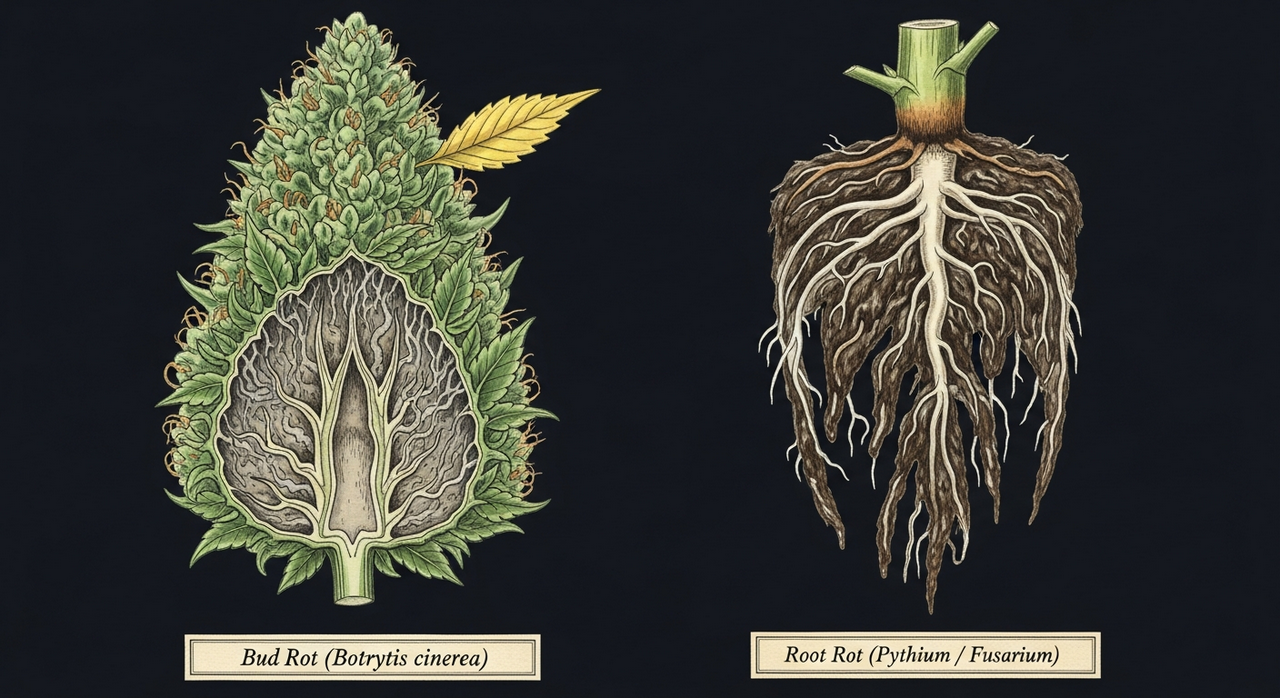
Bud rot. It colonizes from the inside out, hiding in the densest parts of your canopy where airflow is worst and humidity is highest. By the time the exterior shows damage, the interior has been decomposing for days.
Read more...
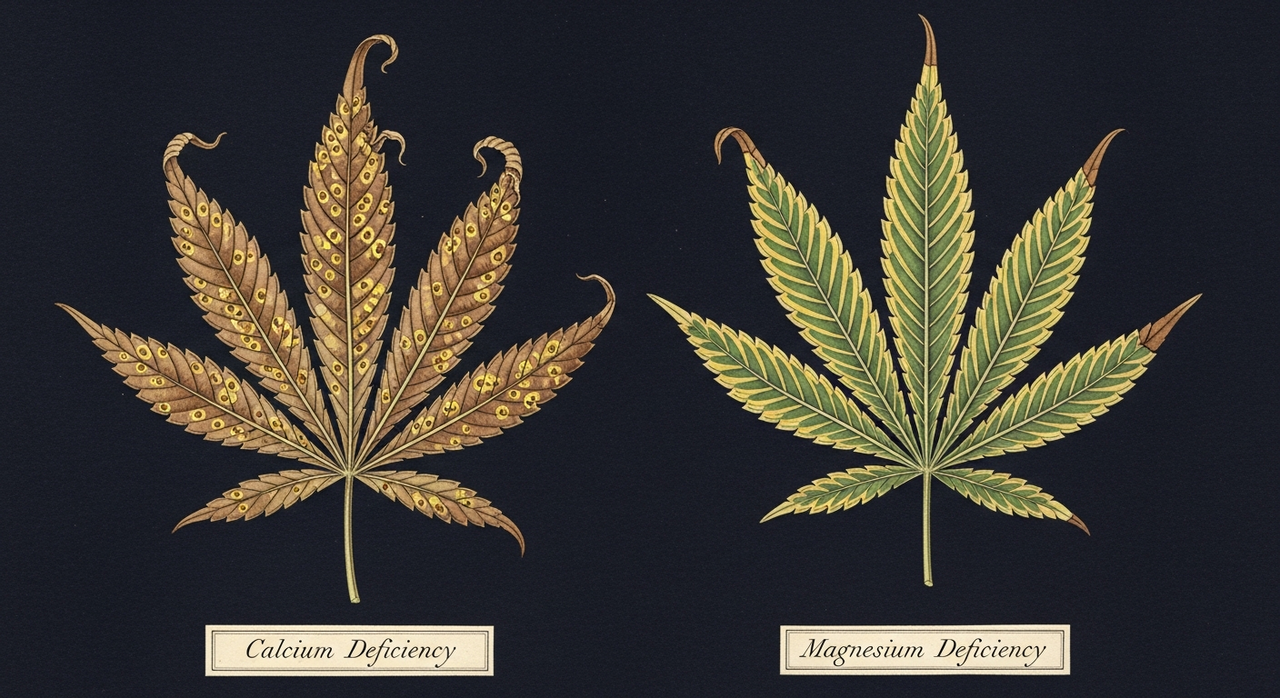
Something’s wrong with your plant. The leaves look off. You post a photo to a growing forum and within minutes, three people reply: “CalMag.”
You could have posted a picture of your dog and someone would have said CalMag.
It’s the universal answer to every cannabis problem, the “have you tried turning it off and on again” of indoor growing. Yellowing? CalMag. Spots? CalMag. Weird leaf curl? Believe it or not, CalMag. And hey - sometimes it works. But when it doesn’t, most growers just add more CalMag, which can make things actively worse.
Read more...
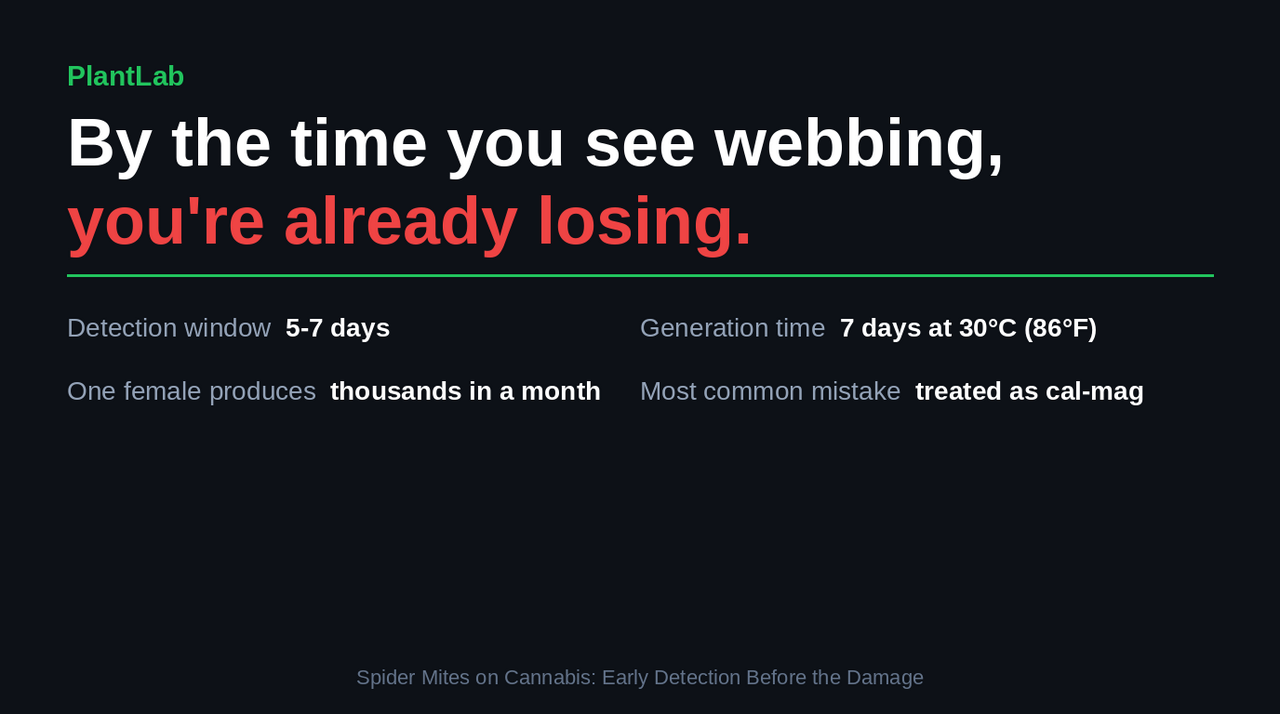
You adjusted your cal-mag for two weeks. The yellowing got worse. Then you saw the webbing.
That’s how most growers discover spider mites - not when the problem starts, but when it’s already out of control. The early damage looks so much like a nutrient deficiency that your first instinct is to adjust the feed. Meanwhile, a single female mite is producing thousands of descendants in a month.
Read more...
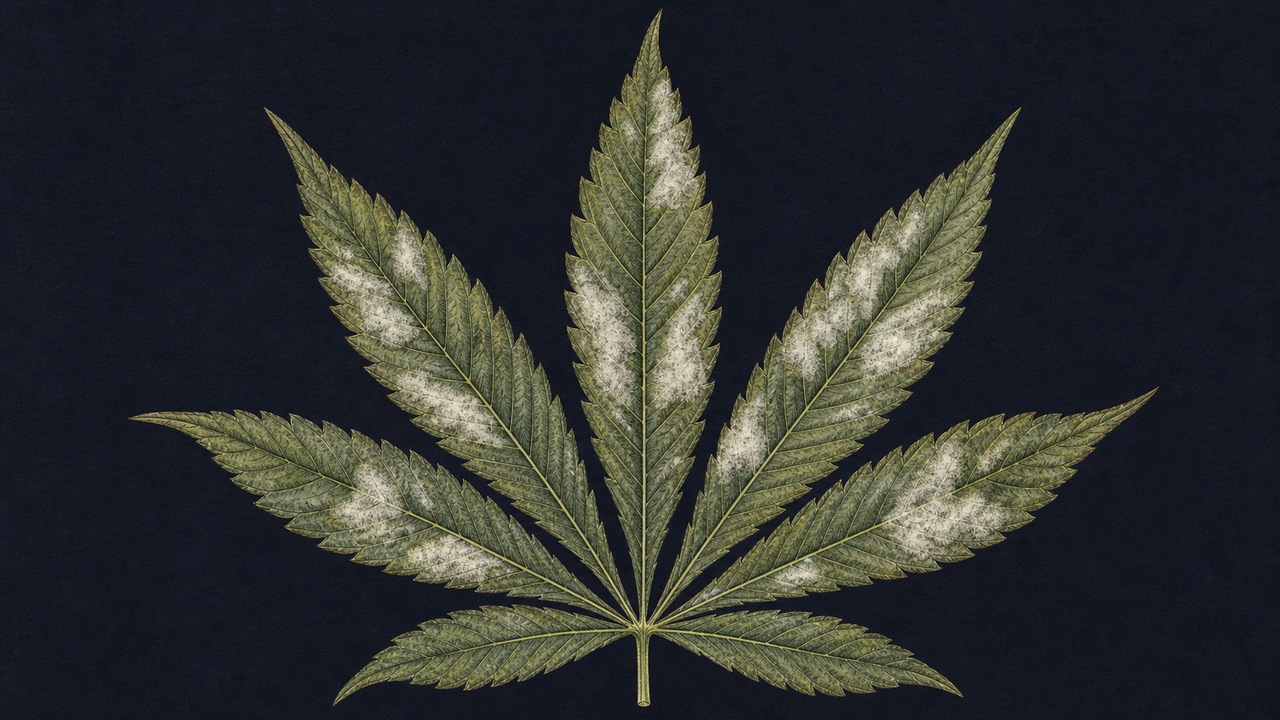
It looks like your plant is getting frosty. White powder spreading across the leaves, that pale shimmer catching the grow light. Then you touch it, and your finger comes away white.
That’s not trichome development. That’s powdery mildew - and if you’re seeing it now, the infection has been active inside your plant for up to two weeks already.
Read more...
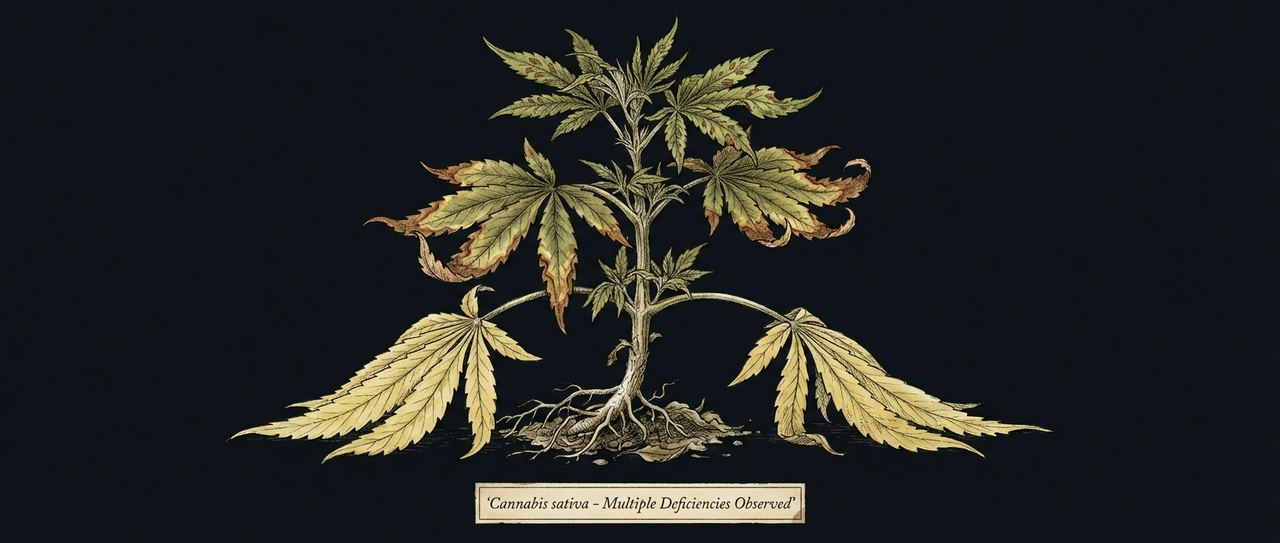
Start with the affected leaves To narrow down a cannabis plant problem, note which leaves changed first, inspect both sides for pests, and check the growing conditions. Yellowing, brown edges, and curling each have several possible causes. One symptom does not confirm a diagnosis.
What you see Compare next Yellow older leaves Nitrogen deficiency Brown spots or yellowing between veins Calcium vs magnesium deficiency Brown, crisp leaf edges Potassium deficiency and similar symptoms Silver scars and tiny dark specks Thrips identification Pale dots or fine webbing Spider mite identification Brown tissue inside flowers or damaged roots Bud rot vs root rot Read more...
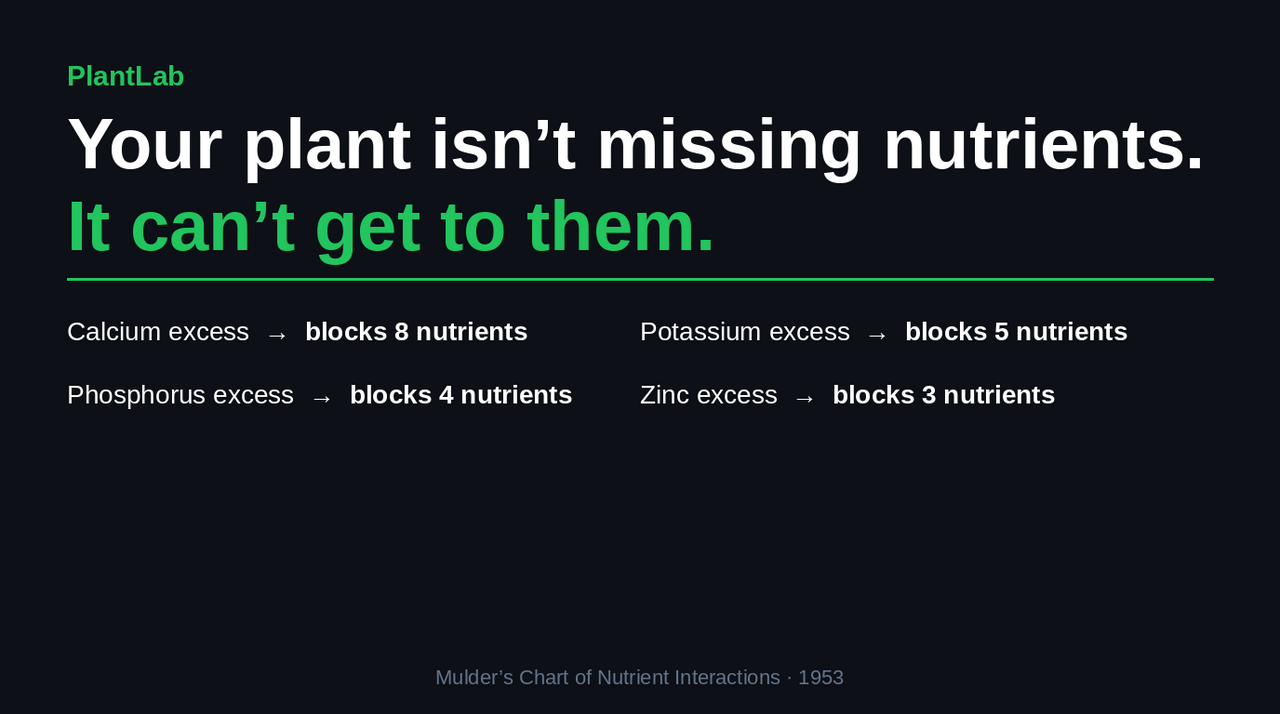
The Short Version Nutrient antagonism is when excess of one nutrient physically blocks another from being absorbed - your plant has enough of what it needs, it just can’t get to it. Adding more of the blocked nutrient usually makes things worse. A 1953 agricultural chart called the Mulder’s Chart maps all of these interference relationships; PlantLab’s diagnosis now applies that same logic automatically, flagging the most likely excess nutrient in every analysis.
What this post covers:
Why “add more” is sometimes the exact wrong answer The Mulder’s Chart: what it shows and how to read it The four antagonism traps cannabis growers hit most often How to tell antagonism from a true deficiency What to actually do once you’ve identified the likely excess You’re three weeks into flower. New growth is showing interveinal chlorosis - yellowing between the veins. Classic iron deficiency. You’ve seen it before. You adjust your pH, add some chelated iron, wait a few days. Nothing. You add more. The leaves get worse. Two weeks of this and your runoff EC looks completely normal. What is going on?!
Here’s the thing: your plant probably has plenty of iron. The problem is that something else is blocking it from getting in. You’re chasing a deficiency that isn’t really there.
Read more...
Nitrogen deficiency in cannabis appears as yellowing of lower, older leaves that progresses upward from the bottom of the plant. Because nitrogen is a mobile nutrient, the plant moves it from old growth to support new leaves. The key diagnostic marker is that yellowing includes the veins - unlike iron or magnesium deficiency where veins stay green.
Quick checklist:
Yellowing starts on BOTTOM leaves Yellowing includes veins (not just between veins) New growth at top still green Leaves may cup upward before falling off If yellowing appears on top/new growth first, it is NOT nitrogen deficiency.
Read more...
The Problem Let’s say you are a new or aspiring cultivator. You got some seeds, soil, nutrients, and the rest of your setup. You plant the seed and in a few days a little sprout starts growing. You hope that all goes according to the instructions you read or videos you watched. But at some point, your plant looks a little off. Perhaps the leaves are curling or its color changes. Something doesn’t seem right. You search online, post photos on growing forums. You adjust pH, nutrients, lights. Sometimes the plant bounces back and sometimes it doesn’t. You wish you could get a clear signal about what’s going on, so you can actually address it.
Or perhaps you are an advanced grower, with a large tent or greenhouse. Daily, you walk and examine your plants, checking for signs of stress or pests. The more plants you have, the more chances something goes amiss and needs your attention. Your systems for lights, pH, water may be automated but they still need you: your vision and your experience.
Read more...