Bud Rot and Root Rot in Cannabis: Detection Before It's Too Late
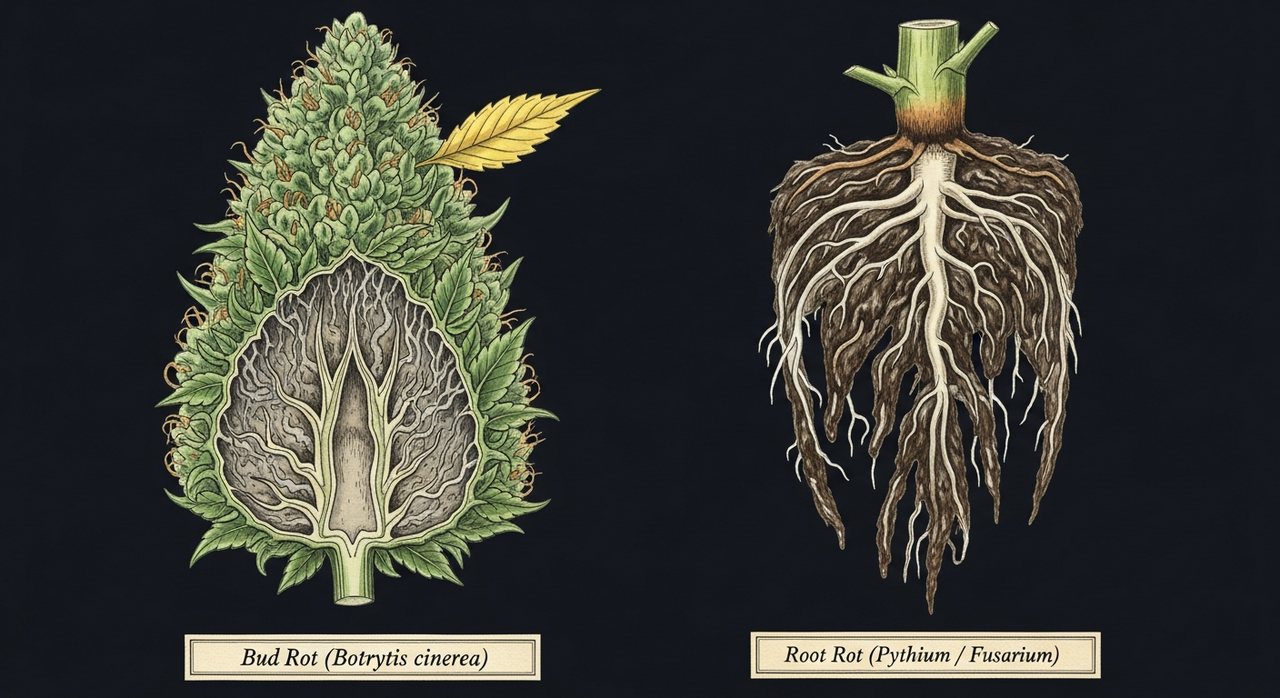
You won't smell it at first. By the time you do – that damp, musty sweetness coming off a cola that looked fine yesterday – you've already lost that bud and probably the ones touching it. You cut it open, and the inside is grey mush. A week from harvest.
Bud rot. It colonizes from the inside out, hiding in the densest parts of your canopy where airflow is worst and humidity is highest. By the time the exterior shows damage, the interior has been decomposing for days.
Root rot is the same story, underground. A plant that was drinking normally starts drooping despite a wet medium. You check the roots and they're brown, slimy, and smell like a swamp. The pathogen has been destroying the root system for a week before the canopy showed a single symptom.
What they share: the window between “detectable” and “devastating” is days, not weeks. Nutrient deficiencies give you time. Pest infestations give you time. Rot doesn't. It doubles and doubles, and by the time most growers catch it, the only option left is damage control.
Quick Identification
Bud rot is caused by Botrytis cinerea, a fungus that colonizes dense flower clusters from the inside out. The first thing you'll notice: a sugar leaf or two within a cola turning yellow or brown while everything around it stays healthy. That isolated patch of dead tissue – not matching any nutrient pattern – is your warning. Pull the bud apart and you'll find grey or brown tissue, soft and wet, with grey-white fuzz (mycelium) growing through it.
Root rot comes from several pathogens – water molds like Pythium (especially common in hydro) and true fungi like Fusarium (which hits both soil and hydro). The first sign is a plant that droops for no obvious reason even though you just watered. Growth slows. Roots shift from white to tan or brown. By the time the roots are dark brown, slimy, and smell rotten, the plant may not recover.
What separates rot from everything else: it's local. One cola dying while the rest of the plant looks fine. One section of roots going brown while others stay white. Nutrient deficiencies hit the whole plant uniformly. Rot has an epicenter.
Bud Rot: What to Look For
The Inside-Out Problem
Bud rot starts where you can't see it. Botrytis spores land on flower tissue, germinate in the humidity, and go straight for the densest part of the bud – the interior, where moisture sits longest. Outside? Green and healthy. Inside? Grey mush.
Doesn't matter how many cycles you've run. You can eyeball your canopy every day and miss it completely, because the infection is in the one place a surface inspection doesn't reach.
Early Symptoms (Day 1-3)
The first visible sign is almost always a single sugar leaf – or a small cluster of them – within a cola that yellows and wilts while the rest of the bud stays green. This is easy to dismiss as a light-deprived leaf dying naturally. It isn't.
What to look for: – A single yellowing/browning leaf within an otherwise healthy cola – The leaf pulls out easily with a slight tug (the stem base is already rotting) – The area around the discolored leaf feels softer or more moist than adjacent tissue – A faint musty smell when you press your nose close to the bud
Moderate Symptoms (Day 3-7)
- Brown or grey tissue visible when you gently spread the cola apart
- Multiple leaves in the same bud turning yellow or brown
- White or grey fuzzy mycelium visible inside the bud under magnification
- The affected area feels distinctly wet or spongy
Advanced Symptoms (Day 7+)
- Grey mold visible on the bud exterior
- Bud tissue is soft, wet, and pulls apart easily
- Dark brown or black discoloration spreading to adjacent colas
- Spore dust (grey powder) released when the bud is disturbed
- Unmistakable musty or ammonia smell
At this point, that bud is gone. Everything you do now is about keeping it from spreading.
Where Bud Rot Hits First
Bud rot isn't random. It goes where the moisture is:
Your main cola. Any thick, tightly-packed bud where moisture can't escape. Spots deep in the canopy where leaves overlap and trap humidity. Anywhere a fan leaf rests against a bud, creating a little moisture pocket. And anywhere the bud surface is already damaged – caterpillar bore holes, supercrop scars, anything that gave the fungus a way in.
If you're only going to inspect one thing daily in late flower, make it the main cola and any bud that's touching a fan leaf. That's where bud rot lives.
Root Rot: What to Look For
The Drooping Paradox
Root rot looks like underwatering. Plant's drooping, so you water it. The drooping gets worse, so you water more. And now you're feeding the exact conditions that are killing the roots.
The tell: is the medium already wet? Overwatering droop and root rot droop look identical from the canopy. The answer is always below the surface.
Early Symptoms (Day 1-5)
- Drooping or wilting even though the medium is wet
- Slowed growth rate compared to other plants in the same environment
- Roots shifting from bright white to off-white or light tan
- Slight sour or stale smell from the root zone (especially in hydro)
Moderate Symptoms (Day 5-14)
- Roots turning brown and developing a slimy texture
- Leaves yellowing from the bottom up (mimics nitrogen deficiency)
- Plant drinking less water than expected for its size
- Stems near the base feeling soft or mushy
- Distinct foul odor from the root zone
Advanced Symptoms (Day 14+)
- Dark brown, mushy root mass that falls apart when touched
- Severe wilting that doesn't recover with watering
- Lower leaves dropping rapidly
- Base of stem may show brown discoloration
- The entire root zone smells of decay
Hydro vs Soil vs Coco
Root rot behaves differently across growing media:
| Factor | Hydroponic (DWC/NFT) | Coco Coir | Soil |
|---|---|---|---|
| Primary pathogen | Pythium (also Fusarium) | Pythium / Fusarium | Fusarium / Phytophthora |
| Speed of onset | Fast (2-5 days) | Moderate (5-10 days) | Slow (7-14 days) |
| First sign | Slimy roots, off smell | Drooping, slow drying | Persistent droop |
| Temperature trigger | Reservoir > 22C / 72F | Overwatering + warm | Overwatering + poor drainage |
| Visibility | Easy (roots exposed) | Moderate (can pull back medium) | Hard (roots buried) |
Hydroponic growers have one advantage here: you can actually see the roots. Check them daily. One brown root tip caught early is a ten-second trim. Caught late, it's a dead plant.
Why Speed Matters More Than Treatment
Most treatment guides bury the uncomfortable truth: by the time you've confirmed rot, your best options are already behind you. Both conditions double fast once established, and the pathogens produce spores (bud rot) or zoospores (root rot) that reinfect tissue you've already treated.
For bud rot: – Day 1-3: Remove affected cola plus 2-3cm of healthy tissue around it. Sterilize cutting tool between cuts. Drop humidity below 50%. Increase airflow. The remaining harvest is likely safe. – Day 4-7: You're removing multiple colas. Some adjacent buds may be internally compromised but not yet showing symptoms. Harvest early if possible. – Day 7+: Salvage what you can. Anything near the infected area should be assumed compromised.
For root rot: – Early stage: Hydrogen peroxide root drench (3ml of 3% H2O2 per liter for mild cases, up to 5ml/L for aggressive treatment), drop reservoir temperature below 20C / 68F, increase dissolved oxygen. Beneficial microbes (Bacillus, Trichoderma) as a preventive – not a cure, but they compete with pathogens. Note: H2O2 kills beneficials too, so don't use both simultaneously. – Moderate stage: Root pruning (remove all brown tissue), full reservoir change, lower temperature, and hope the remaining root mass can support the plant. – Advanced: The plant is dying. What's left of the root system can't support it. Sometimes the honest move is to pull it and focus on the plants you can still save.
Every day you don't catch it, your options get worse. Two days is the difference between losing one cola and losing a quarter of the canopy.
How to Distinguish Rot from Other Problems
Early rot symptoms can look like nutrient deficiencies, overwatering, or heat stress. The giveaway is where the damage is concentrated.
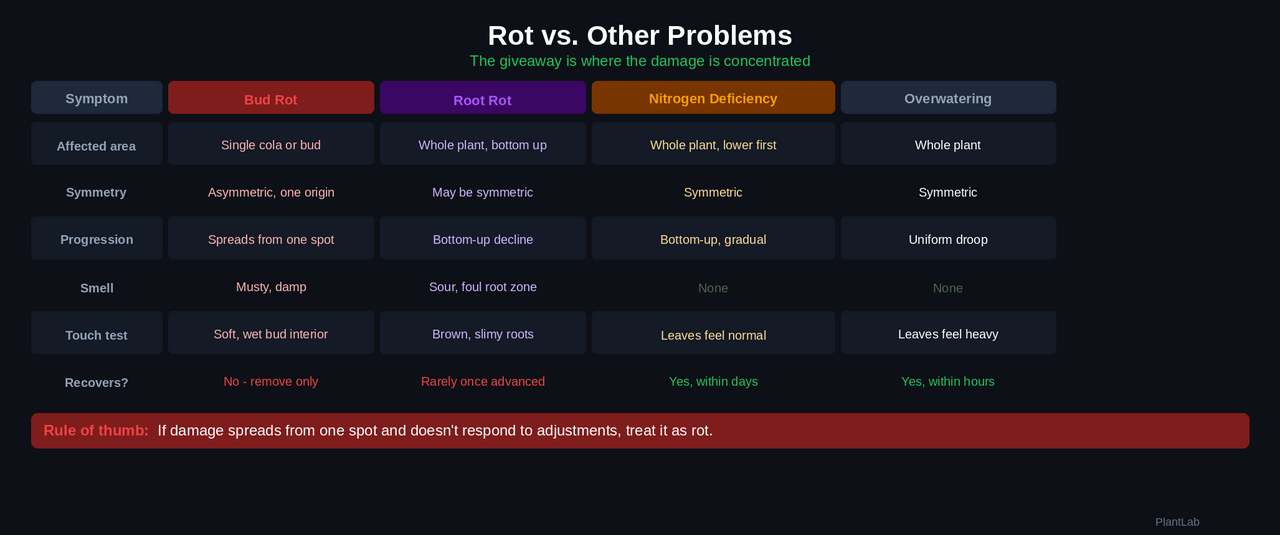
| Symptom | Bud Rot | Root Rot | Nitrogen Deficiency | Overwatering |
|---|---|---|---|---|
| Affected area | Single cola or bud site | Whole plant from bottom up | Whole plant, lower leaves first | Whole plant |
| Symmetry | Asymmetric – one point of origin | May be symmetric | Symmetric | Symmetric |
| Progression | Spreads from one spot outward | Bottom-up canopy decline | Bottom-up, gradual | Uniform droop |
| Smell | Musty, damp | Sour, foul root zone | None | None |
| Physical touch test | Soft, wet bud interior | Brown, slimy roots | Leaves feel normal | Leaves feel heavy |
| Recovers with adjustment | No – removal is the only fix | Rarely once advanced | Yes, within days | Yes, within hours |
If damage is spreading from one spot and doesn't respond to feed or environment changes – treat it as rot. Verify later. You don't have time to be wrong slowly.
Environmental Triggers
Rot is an environmental disease. The pathogen is probably already in your grow room – Botrytis spores are everywhere. But it needs specific conditions to take hold.
Bud Rot Triggers
- Humidity above 60% during flower – this is the one that matters most
- Poor airflow through the canopy, especially within dense colas
- Temperature swings that cause condensation on flower tissue (lights-off drops are the usual culprit)
- Dense genetics – strains bred for bag appeal often produce bud structures that trap moisture
- Late flower, week 6-8, when buds are at their densest and you're tired of babysitting the dehumidifier
Root Rot Triggers
- Reservoir temperature above 22C / 72F in hydro – this is the big one
- Overwatering in any medium, especially with poor drainage
- Low dissolved oxygen in the root zone
- Contaminated medium or tools (reusing coco without sterilizing, dirty res)
- Dead organic matter sitting in the reservoir
The 60/22 Rule
Two numbers. That's all you need to remember: flower room humidity below 60%, reservoir temperature below 22C / 72F. Not arbitrary – those are the inflection points where Botrytis and Pythium growth rates drop off hard. Stay below them and you're making it difficult for the pathogen. Go above and you're rolling out a welcome mat.
Catching It Before You Can
With rot, speed is the whole game. Early symptoms look like half a dozen other things, and most growers burn their response time treating the wrong problem.
PlantLab's vision model detects both bud rot and root rot as distinct conditions. You get a specific diagnosis with a confidence score, not “something might be wrong with your plant.” The model was trained exclusively on cannabis images – over 2,000 verified bud rot samples alone – across every severity stage from the first discolored leaf to full colonization.
If you're growing one plant, daily inspection is enough. But for a larger canopy – or if you're running cameras on a timer – a system that flags bud rot at 6 AM on a Tuesday before you walk into the room is worth having.
Try it free at plantlab.ai.
FAQ
How fast does bud rot spread?
Fast. An entire cola can go from first visible symptom to grey mush in 48-72 hours under favorable conditions (humidity above 60%, poor airflow). During that window, spores are landing on neighboring buds and starting new infections that won't show for days. Inspect your densest colas daily in late flower. There's no substitute.
Can you save a bud with rot?
No. Once Botrytis is inside the flower structure, that bud is done. Cut the affected cola plus a margin of healthy tissue around it, sterilize your tool between cuts, and get humidity down. Everything after detection is about containment, not cure.
Does hydrogen peroxide cure root rot?
It kills Pythium on contact, but it also nukes every beneficial microbe in the root zone. Think of it as a reset button, not a treatment plan. Use it alongside temperature correction (below 22C / 72F) and better oxygenation. Once most of the roots are brown and slimy, H2O2 won't save the plant – there's not enough healthy root mass left to recover from.
Why does my plant droop even though the soil is wet?
Rotting roots can't absorb water even when they're sitting in it. The plant wilts, you water more, the root zone stays waterlogged, and the pathogen thrives. If a plant droops and the medium is already wet, stop watering and check the roots.
Can bud rot spread to other plants?
Absolutely. Botrytis cinerea produces airborne spores, and disturbing an infected bud – touching it, cutting it, even a fan blowing across it – sends them into the air. They land on neighboring plants and start the cycle over. When you remove infected colas, work carefully and bag the tissue immediately. Some growers hit neighboring plants with a preventive fungicide application after removal, which isn't a bad idea.
Related reading
- Fungus Gnats on Cannabis: The Wet-Soil Pest That Looks Like Root Rot – the pest whose larvae open the root wounds that root rot moves into
- Powdery Mildew on Cannabis: Visual Detection and Prevention – the other major fungal disease, and the humidity conditions both share
- What's Wrong With My Cannabis Plant? A Visual Diagnosis Guide – the full symptom-to-cause quick reference