What's Wrong With My Cannabis Plant? A Visual Diagnosis Guide
Start Here
Something looks wrong. Maybe the bottom leaves are yellowing. Maybe the tips are curling. Maybe you walked into your tent and something just looked off in a way you can't articulate but your gut knows isn't right.
So you did what every grower does: you took a photo, posted it online, and got twelve different answers. Someone said CalMag. Someone said flush. Someone said “two more weeks.” None of them agreed on what the actual problem is.
This guide won't do that. It walks through a systematic process: look at where the damage is, what it looks like, and narrow it down to a specific cause. No guessing, no bro science, no “could be anything, hard to tell from the photo.”
Step 1: Where Are the Symptoms?
Look at where the damage is happening. Location tells you more than color does.
| Symptom Location | Most Likely Causes |
|---|---|
| Bottom/older leaves first | Nitrogen deficiency, magnesium deficiency, potassium deficiency |
| Top/new growth first | Iron deficiency, calcium deficiency, light burn, heat stress |
| Entire plant | Overwatering, underwatering, pH lockout, root problems |
| Leaf surfaces (spots/patches) | Pests (spider mites, thrips), diseases (septoria, powdery mildew) |
| Buds/flowers | Bud rot, caterpillars, light burn |
| Stems/branches | Phosphorus deficiency, fusarium, root rot |
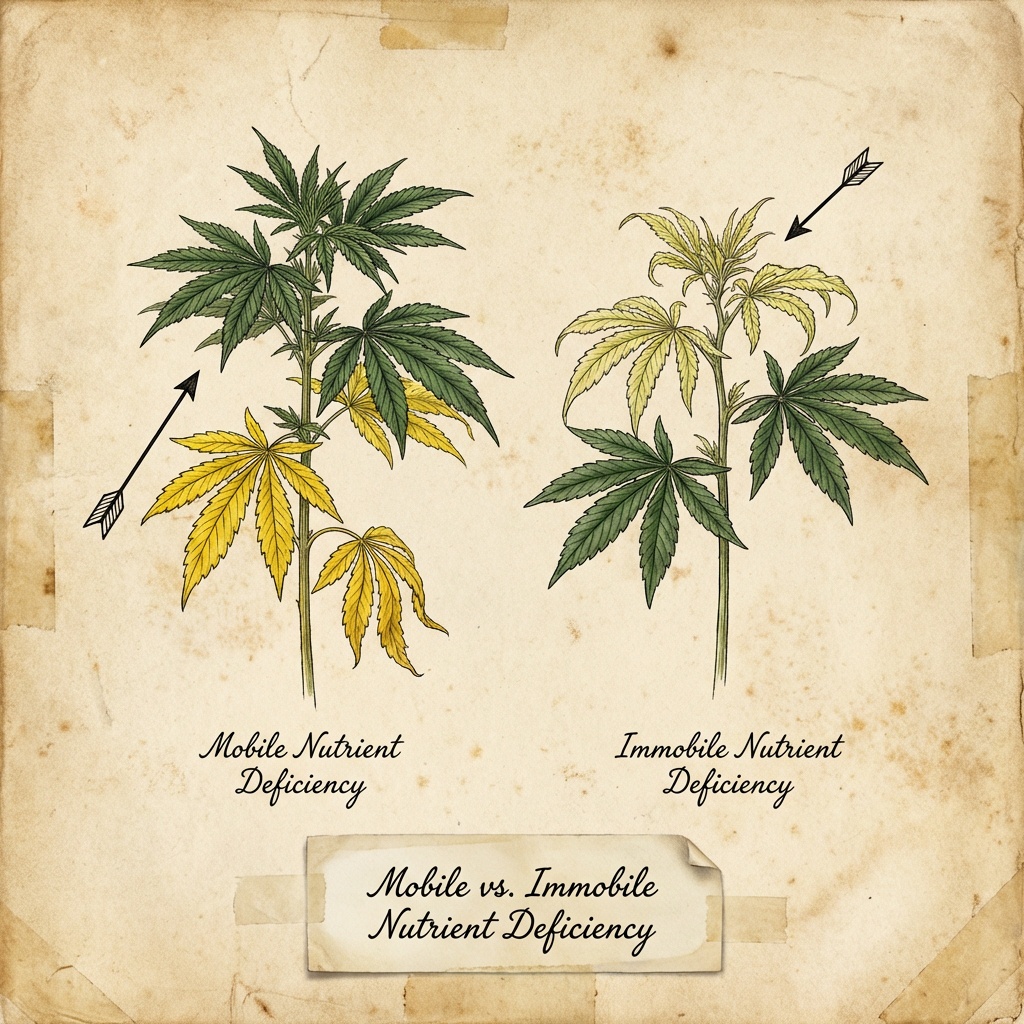
Here's the rule that eliminates half the guesswork: mobile nutrients (nitrogen, magnesium, potassium, phosphorus) move from old leaves to new ones. When they run low, old growth sacrifices itself first. Immobile nutrients (iron, calcium) stay put – so deficiency shows up on new growth first.
Bottom-up damage? Mobile nutrient problem. Top-down damage? Immobile nutrient or environmental. That single distinction saves you from chasing the wrong diagnosis for a week.
Step 2: What Do the Leaves Look Like?
Yellow Leaves
Ah, yellow leaves. The “check engine light” of cannabis growing. Universally alarming, completely nonspecific. Seven different things cause yellowing, and the forum advice for all of them is “probably CalMag.” The pattern of yellowing is what actually matters.
| Yellow Pattern | Condition | How to Tell |
|---|---|---|
| Uniform yellowing, bottom leaves, veins included | Nitrogen deficiency | The whole leaf goes pale – veins too. Oldest leaves die first while new growth stays green. The classic. |
| Yellow between veins, bottom leaves, veins stay green | Magnesium deficiency | The leaf looks striped – green veins on yellow background. Often appears mid-to-late flower. This is the one where CalMag actually might be the answer. |
| Yellow between veins, top/new leaves, veins stay green | Iron deficiency | Identical pattern to magnesium, but on new growth instead of old. Easy to confuse the two if you're not paying attention to which leaves are affected. |
| Yellow leaf edges progressing inward | Potassium deficiency | Starts as yellow margins, turns brown and crispy. Sometimes mistaken for nute burn but the pattern is too consistent and progressive. |
| Yellow spots with brown centers | Calcium deficiency | Irregular brown/bronze splotches on newer growth in veg, but can appear on lower fan leaves during flower. Leaves may also twist or distort. |
| Uniform pale yellow, all over | pH lockout | Every nutrient is present in the soil. The plant just can't access any of it because pH is off. Fix pH first, wait 5 days, then reassess. |
| Yellow and drooping | Overwatering | The leaves feel heavy and waterlogged, not crispy and dry. The soil is still wet. You watered it because you were worried about it and now it's worse. We've all been there. |
Bottom-up yellowing with veins turning yellow? That's nitrogen deficiency – the single most common issue for cannabis growers. See our complete nitrogen deficiency guide.
Yellow leaves but genuinely can't tell which deficiency? You're not alone – even experienced growers get these confused. PlantLab's AI was specifically trained to distinguish between 7 nutrient deficiencies that look nearly identical to the human eye. It's more reliable than asking strangers on Reddit, and faster than waiting three days for the wrong treatment to not work.
Brown Spots and Edges
| Brown Pattern | Condition | How to Tell |
|---|---|---|
| Brown crispy edges, leaf margins | Potassium deficiency | Edges burn inward from the margins. Bottom leaves first. Often shows up in flower when K demand spikes. |
| Brown/bronze spots expanding over time | Calcium deficiency | Newer growth in veg, lower fan leaves in flower. Spots are irregular with browning edges, not perfectly round. |
| Brown spots with target-like pattern | Leaf septoria | Dark center ringed by lighter brown and a yellow halo – a bullseye pattern. Shape is roughly circular to irregular. Lower canopy in humid conditions. |
| Brown/gray mush inside buds | Bud rot (Botrytis) | The one that keeps growers up at night. Internal mold that starts inside your densest colas. By the time you see it on the outside, the inside is already gone. |
| Brown/rust colored bumps | Rust fungus | Raised bumps on leaf undersides, like tiny blisters. Often overlooked until it's widespread. |
Curling Leaves
| Curl Direction | Condition | How to Tell |
|---|---|---|
| Curling UP (taco-ing) | Heat stress, light stress | The plant is folding its leaves to reduce the surface area exposed to your too-close light. Top canopy affected most. |
| Curling DOWN (the claw) | Nitrogen toxicity | Dark green, glossy, tips hooking downward. The plant equivalent of drinking too much coffee. You overfed it. |
| Edges curling up | Potassium deficiency, heat | If the edges are also brown and crispy, it's K. If just curling, it's heat. |
| New growth twisted/distorted | Calcium deficiency | New leaves come in looking wrong – twisted, cupped, malformed. Not just curling, actually misshapen. |
White or Discolored Patches
| Appearance | Condition | How to Tell |
|---|---|---|
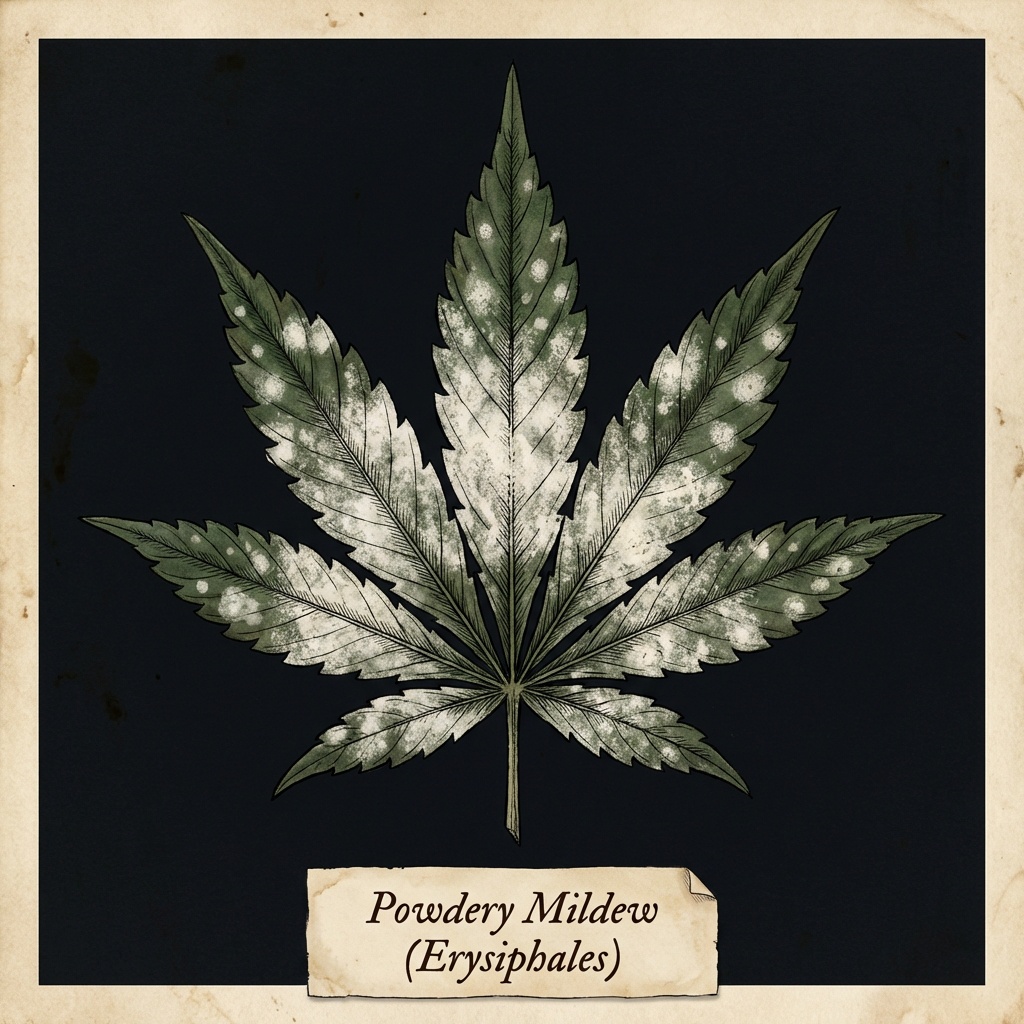
| White powdery coating | Powdery mildew | On fan leaves: wipes off with your finger, leaving clean green underneath. On sugar leaves near buds where trichomes are dense, the wipe test is unreliable – use a 10x loupe instead. PM looks flat and dusty; trichomes are three-dimensional with visible stalks and mushroom-shaped caps. |
 | White webbing between leaves | Spider mites | Fine webs between branches. Flip a leaf over – if you see tiny moving dots, you have a serious problem. |
| Bleached/white tips | Light burn | Primarily on the top canopy, closest leaves to your light. Move the light up. |
| Purple/red stems and undersides | Phosphorus deficiency, cold, or genetics | Three common causes: (1) genetics – many strains naturally run purple stems, (2) cold temperatures below 60F/15C trigger anthocyanin production independently of nutrition, (3) actual P deficiency, which also causes dark leaves, slow growth, and stiff/brittle foliage. If purple stems are the only symptom, it's almost certainly not phosphorus. |
| White webbing between leaves | Spider mites | Fine webs between branches. Flip a leaf over – if you see tiny moving dots, you have a serious problem. |
| Bleached/white tips | Light burn | Primarily on the top canopy, closest leaves to your light. Move the light up. |
| Purple/red stems and undersides | Phosphorus deficiency, cold, or genetics | Three common causes: (1) genetics – many strains naturally run purple stems, (2) cold temperatures below 60F/15C trigger anthocyanin production independently of nutrition, (3) actual P deficiency, which also causes dark leaves, slow growth, and stiff/brittle foliage. If purple stems are the only symptom, it's almost certainly not phosphorus. |
Step 3: Check for Pests
Pests leave evidence. Nutrient deficiencies create patterns. Knowing the difference matters – treating the wrong cause wastes time and can make things worse.
A jeweler's loupe is the single best diagnostic tool you can own. A 10x loupe ($8) catches most pests; a 60x pocket microscope ($15) is needed for broad mites and russet mites, which are invisible at lower magnification.
| Pest | What You See | Where to Look |
|---|---|---|
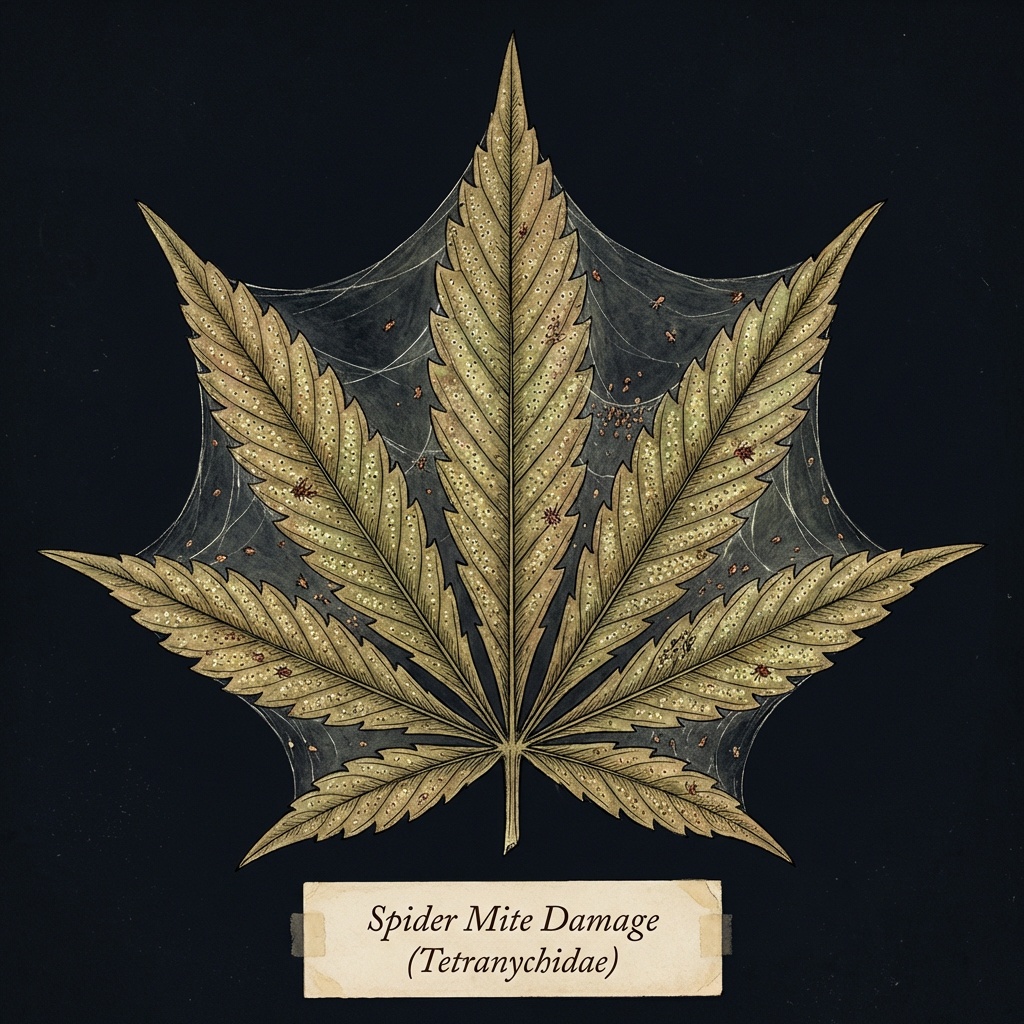
| Spider mites | Fine webbing, tiny dots on leaves, stippling damage | Leaf undersides, near veins. By the time you see webs, the colony is already massive. |
 | Thrips | Silver/bronze streaks, tiny elongated insects | Upper leaf surfaces, inside new growth. The streaks are where they've been feeding. |
| Aphids | Clusters of small bugs, sticky residue (honeydew) | Stems, new growth tips. They reproduce fast – a few today, hundreds next week. |
| Broad mites / Russet mites | Twisted, distorted new growth; glossy or plastic-looking leaves; stunted tops | Invisible to the naked eye (need 60x+ magnification). Often misdiagnosed as heat stress, pH problems, or calcium deficiency. One of the most devastating cannabis pests because they're identified too late. |
| Fungus gnats | Small flies near soil surface | Topsoil, especially in chronically overwatered pots. Adults are harmless; larvae feed on root hairs and create entry points for pathogens like Fusarium and Pythium. Dangerous for seedlings, less so for established plants unless the infestation is heavy. |
| Whiteflies | Cloud of tiny white insects when plant is disturbed | Leaf undersides. Shake the plant gently – if a cloud of tiny white things takes off, you know. |
| Caterpillars | Frass on/near buds, unexplained cola browning, holes in leaves | Inside buds, under leaves, along stems. Outdoor grows especially. The real threat is budworms boring into dense colas – the frass they leave behind promotes bud rot, which is often worse than the direct feeding damage. |
| Thrips | Silver/bronze streaks, tiny elongated insects | Upper leaf surfaces, inside new growth. The streaks are where they've been feeding. |
| Aphids | Clusters of small bugs, sticky residue (honeydew) | Stems, new growth tips. They reproduce fast – a few today, hundreds next week. |
| Broad mites / Russet mites | Twisted, distorted new growth; glossy or plastic-looking leaves; stunted tops | Invisible to the naked eye (need 60x+ magnification). Often misdiagnosed as heat stress, pH problems, or calcium deficiency. One of the most devastating cannabis pests because they're identified too late. |
| Fungus gnats | Small flies near soil surface | Topsoil, especially in chronically overwatered pots. Adults are harmless; larvae feed on root hairs and create entry points for pathogens like Fusarium and Pythium. Dangerous for seedlings, less so for established plants unless the infestation is heavy. |
| Whiteflies | Cloud of tiny white insects when plant is disturbed | Leaf undersides. Shake the plant gently – if a cloud of tiny white things takes off, you know. |
| Caterpillars | Frass on/near buds, unexplained cola browning, holes in leaves | Inside buds, under leaves, along stems. Outdoor grows especially. The real threat is budworms boring into dense colas – the frass they leave behind promotes bud rot, which is often worse than the direct feeding damage. |
The key distinction: Pest damage is random and localized – wherever the pest fed. Nutrient deficiencies are systematic – they follow predictable patterns based on nutrient mobility. If the damage pattern doesn't make sense for any deficiency, get the loupe out.
Step 4: Rule Out the Usual Suspects First
Before you diagnose a deficiency and start adjusting nutrients, check the three things that cause most of the problems most of the time. Boring advice, but it would prevent about 60% of the “what's wrong with my plant” posts on every growing forum.
pH (The Actual Answer to Most Problems)
Here's the uncomfortable truth: the majority of “deficiency” symptoms in cannabis are actually pH lockout. Every nutrient is sitting right there in the soil. The plant just can't absorb any of it because the pH is wrong.
| Medium | Ideal pH Range |
|---|---|
| Soil | 6.0 – 7.0 |
| Coco coir | 5.5 – 6.5 |
| Hydro/DWC | 5.5 – 6.0 |
Check your pH before you diagnose anything. If it's off, fix it, wait 3-5 days, then see if the symptoms are still progressing. This is less exciting than diagnosing a rare micronutrient deficiency, but it's correct far more often. “pH your water bro” is the one piece of forum advice that's right almost every time.
Watering (The Other Usual Suspect)
| Symptom | Overwatering | Underwatering |
|---|---|---|
| Leaves | Drooping, heavy, plump | Drooping, dry, thin |
| Soil | Wet, slow to dry | Dry, pulling from pot edges |
| Recovery time | Slow (2-3 days) | Fast (hours after watering) |
| Pot weight | Heavy | Light |
The “lift the pot” test is free and takes one second. If the pot is heavy, stop watering. If it's light, water it. More sophisticated than most diagnostic protocols, honestly.
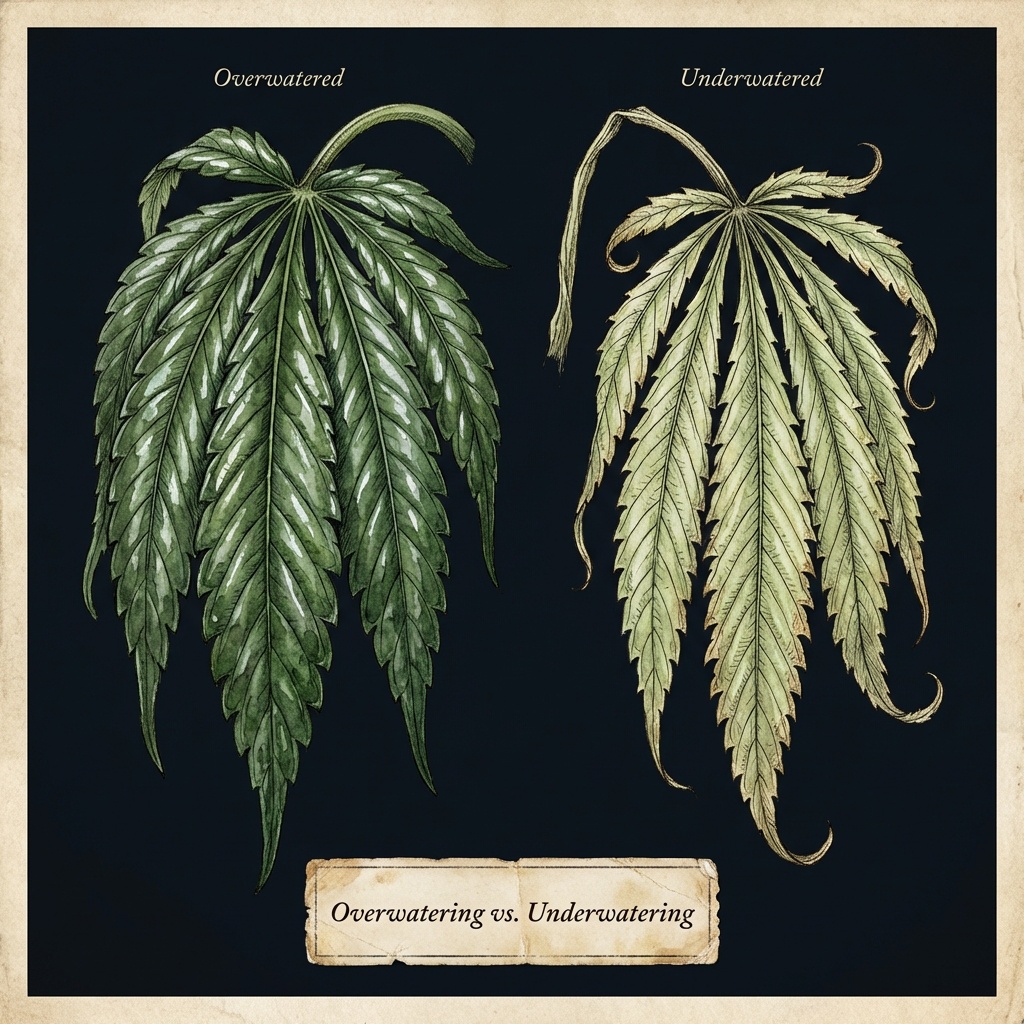
New growers overwater because they're paying too much attention. The plant doesn't need water every day. If the soil is still moist 2 inches down, walk away. Watering your plant because you're anxious about it is the gardening equivalent of refreshing your email.
Light and Heat
- Light burn: Bleached/white leaf tips closest to light. Your light is too close. Move it up.
- Heat stress: Leaves taco upward, fox-tailing in flower. If your hand is uncomfortable at canopy height for 30 seconds, the plant is uncomfortable all day.
- Light deficiency: Stretching, thin stems, pale color. The plant is reaching for something that isn't there.
The Cannabis Deficiency Quick-Reference Chart
For when you've checked pH, watering, and environment and the problem is still getting worse:
| Nutrient | Mobile? | Where It Shows | Primary Symptom | Secondary Symptom |
|---|---|---|---|---|
| Nitrogen (N) | Yes | Old/bottom | Uniform yellowing | Leaves cup upward, fall off |
| Phosphorus (P) | Yes | Old/bottom | Dark leaves, slow growth | Purple stems (also genetics/cold) |
| Potassium (K) | Yes | Old/bottom | Brown crispy edges | Yellow margins |
| Calcium (Ca) | No | New/top (veg), lower leaves (flower) | Brown/bronze spots | Distorted new growth |
| Magnesium (Mg) | Yes | Old/bottom | Interveinal yellowing | Green veins on yellow leaf |
| Iron (Fe) | No | New/top | Interveinal yellowing | Same as Mg but on new leaves |
| Nitrogen tox. | - | All | Dark green, “the claw” | Tips hook down, glossy |
The mobile/immobile rule is worth memorizing. It's the difference between diagnosing in 10 seconds and spending a week on GrowWeedEasy trying to match photos.
When Eyeballing It Isn't Enough
Visual diagnosis works when symptoms are textbook. In reality, symptoms are rarely textbook. They're a blurry phone photo of a leaf under a purple blurple light, and three different conditions look identical at that resolution.
It breaks down especially when:
- Multiple problems overlap – spider mites AND potassium deficiency at the same time. Treat one, miss the other, wonder why the plant isn't recovering.
- Early symptoms are subtle – the difference between “early nitrogen deficiency” and “normal bottom leaf aging” is obvious in a textbook photo and invisible in your tent at 6 AM.
- Similar conditions need distinguishing – potassium vs magnesium deficiency requires comparing leaf position, vein color, edge pattern, and progression simultaneously. This is where “add CalMag and see what happens” comes from – it's not laziness, it's that telling the two apart with your eyes is genuinely hard.
PlantLab's AI was trained specifically on these ambiguities. It analyzes 31 cannabis conditions and can distinguish between 7 nutrient deficiencies that experienced growers regularly confuse. Not because it's smarter than a grower with 20 years of experience – but because it's been trained on 200,000+ images and doesn't get fooled by blurple lighting.
Try it free at plantlab.ai – 3 diagnoses per day, no credit card.
FAQ
What is the most common cannabis plant problem? Nitrogen deficiency, by a wide margin. It's the most common real deficiency, and pH lockout causing symptoms that look like nitrogen deficiency is even more common. If you can only learn to identify one thing, learn what nitrogen deficiency looks like. Then learn to check your pH so you can rule out the fake version.
Why are my weed plant's leaves turning yellow? It depends. (Sorry. But it really does.) Start with where: bottom leaves = nitrogen, magnesium, or potassium. Top leaves = iron or calcium. Everywhere at once = pH lockout or root problems. The answer to “why are my leaves yellow” is always another question: “which leaves, and what does the yellowing pattern look like?” The table in Step 2 above will narrow it down.
How do I tell if my cannabis plant is overwatered or underwatered? Both cause drooping, which is unhelpful. The difference is in the leaves: overwatered leaves feel heavy, plump, and the soil is still wet. Underwatered leaves are papery thin and the plant perks up within hours of getting water. The pot-lift test works: heavy pot = too wet, light pot = too dry. Overwatering is far more common than underwatering, because new growers hover.
Can a cannabis plant have multiple problems at once? Frequently. Stressed plants attract pests, incorrect pH causes cascading lockouts across multiple nutrients, and a spider mite colony feasting on a plant that's already potassium-deficient produces a confusing mess of symptoms. Prioritize the most severe issue first. Fix that, stabilize, then address the next one. Trying to treat everything simultaneously usually means treating nothing effectively.
Should I remove yellow or damaged leaves? If a leaf is mostly brown and crispy, remove it – it's done photosynthesizing and it's just attracting pests. If it's partially yellow, leave it alone. It's still working. The plant will drop it when it's done with it. Never remove more than 20% of foliage at once, or you'll trade a nutrient deficiency for light stress from suddenly exposed lower growth.
What does it mean when my marijuana plant leaves curl up? Usually heat or light stress. The plant is doing what you'd do if someone held a heat lamp over your head – curling up to reduce its exposure. Move the light higher, improve airflow, or reduce intensity. If the curling comes with brown crispy edges, that's potassium deficiency instead. If the leaves are dark green and curling down (the claw), that's nitrogen toxicity – you overfed it.
How do I know if it's a nutrient deficiency or a pest problem? Deficiencies are systematic: they affect leaves in predictable order (old-to-new or new-to-old), create consistent patterns (interveinal, marginal, uniform), and progress gradually. Pest damage is chaotic: random holes, stippling in patches, silvery streaks where something was feeding, and actual visible bugs if you flip leaves over and look. When in doubt, get a 10x loupe and inspect the undersides. If nothing is moving and nothing is webbed, it's probably not pests.
Detailed guides: – Nitrogen Deficiency: Complete Visual Guide – Calcium vs Magnesium Deficiency: A Visual Comparison – Potassium Deficiency: Burnt Edges and Rust Spots – How AI Diagnoses 31 Cannabis Conditions in 18ms – Nutrient Antagonism: When Adding More Makes It Worse – Why I Built PlantLab