Potassium Deficiency in Cannabis: Burnt Edges and Rust Spots
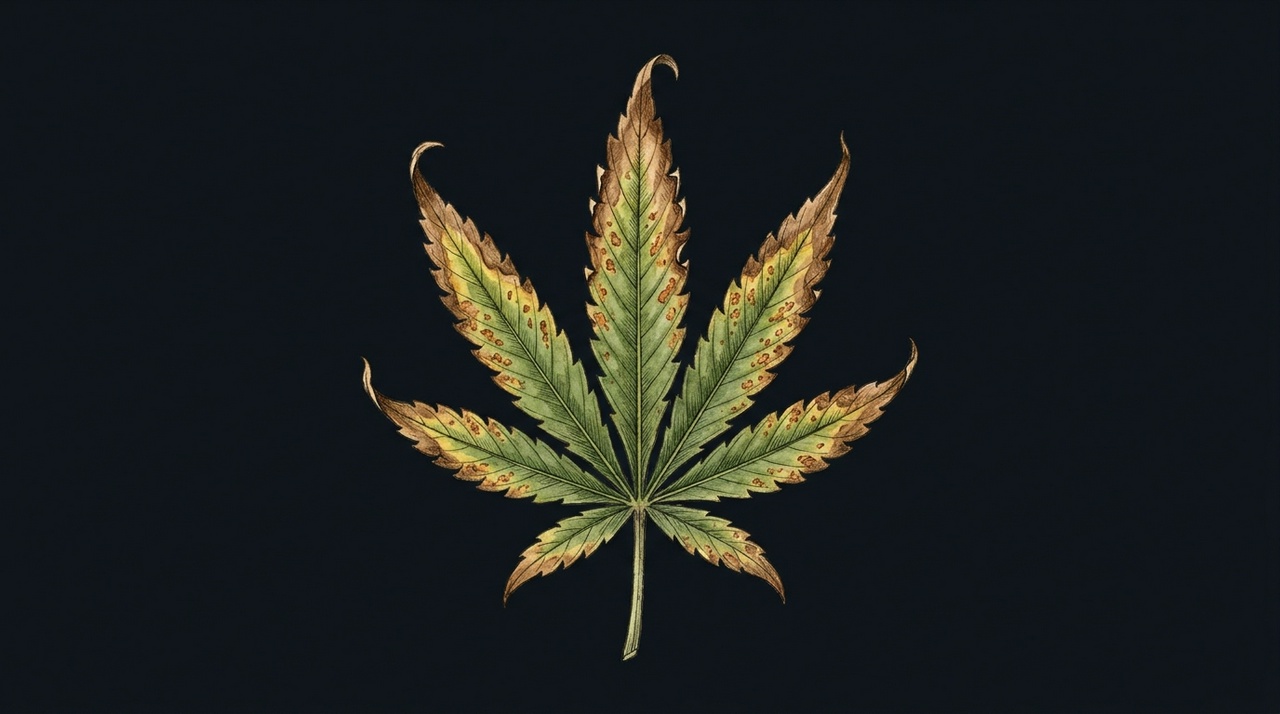
You backed off the feed. The runoff numbers looked high, the tips looked crispy, so you did what every guide says to do when a plant looks overfed: you gave it less. A week later the leaf edges are worse – browner, drier, curling up like burnt paper.
That is the trap with potassium. The classic symptom, scorched leaf margins, looks exactly like the thing you would treat by feeding less. But a potassium-deficient plant is starving, not overfed, and cutting the feed pushes it further down.
This guide covers what potassium deficiency actually looks like on a cannabis plant, why it gets mistaken for nutrient burn and magnesium deficiency, and how to fix it without making the wrong move first.
Quick Identification
Potassium deficiency in cannabis shows up first on the older, lower leaves as yellowing at the leaf edges that browns into dry, crispy margins – a “burnt edge” look – often with rust-colored brown spots scattered across the leaf. Because potassium is a mobile nutrient, the plant pulls it out of old growth to feed new growth, so the bottom of the plant suffers first while the top still looks healthy.
Quick checklist: – Damage starts on LOWER, older leaves – Leaf EDGES and tips scorch brown and dry before the center – Rust or bronze-colored spots freckle the leaf – New top growth still looks fine early on – Whole-plant growth slows and stems may weaken
If the burnt edges are on new top growth, or every leaf tip on the plant is burning at once right after a heavy feed, it is more likely nutrient burn than potassium deficiency.
Why Potassium Matters
Potassium does not build tissue the way nitrogen does. It runs the plant's plumbing. It regulates how the stomata open and close, moves sugars from the leaves to the buds, controls water pressure inside the cells, and helps the plant hold up under heat and drought stress. During flowering, demand climbs because the plant is shipping energy into bud production.
When potassium runs short, the plant triages. It strips the mineral out of its oldest leaves and sends it to the newest growth and the flowers. That is why the damage marches from the bottom up, and why a plant can look fine at the canopy while the lower fan leaves crisp and die.
Common Triggers
Low potassium in the feed is only one cause, and often not the real one. More common culprits:
- pH out of range. Potassium uptake is best in the roughly 6.0 to 7.0 range in soil and 5.5 to 6.5 in hydro. Drift outside that and the plant cannot absorb the potassium that is already there.
- Nutrient lockout from salt buildup. Heavy feeding leaves salts in the medium that block uptake. Ironic, but overfeeding can cause a deficiency.
- Cation competition. Too much calcium, magnesium, or sodium competes with potassium at the root and crowds it out.
- Cold root zone or overwatering. Both slow root function and reduce how much potassium the plant can pull in.
The takeaway: reach for a pH pen before you reach for a potassium supplement. A lockout looks identical to a shortage on the leaf, and dumping more potassium into a locked-out plant only adds to the salt problem.
Visual Symptoms by Stage
Early Signs
- Faint yellowing along the edges of lower fan leaves
- The very tips of some lower leaves start to look dry or singed
- Growth is a little slower than you would expect, though nothing dramatic yet
At this stage it is easy to miss or to write off as light stress or general aging.
Moderate Symptoms
- Leaf margins turn brown and crispy while the center of the leaf stays greener
- Rust-colored or bronze spots appear between the veins and toward the edges
- Edges curl upward and the leaf feels dry and papery
- The damage is clearly worse on the lower half of the plant
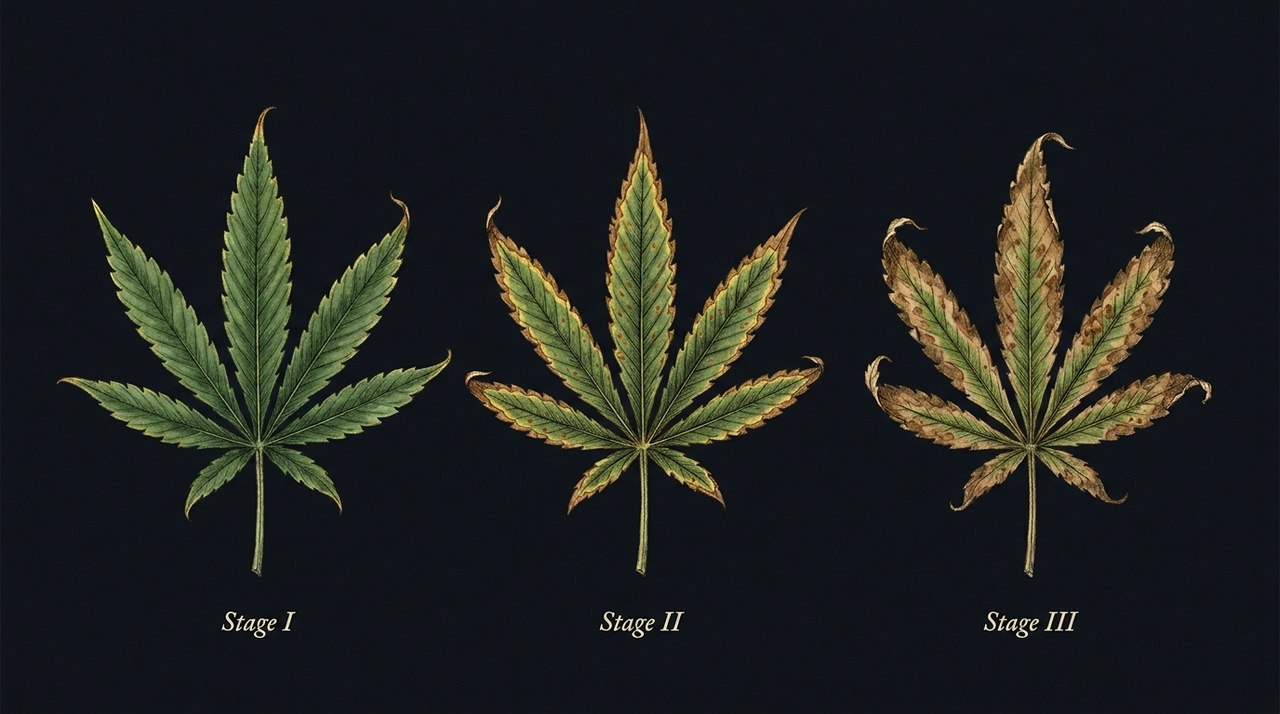
Severe / Advanced
- Whole lower leaves brown, curl, and die back
- Rust spotting spreads and merges into dead patches
- Stems weaken and the plant loses vigor
- In flower, bud development stalls and yields take a real hit
Potassium deficiency in late flower is especially costly because that is exactly when the plant needs potassium to fill out buds.
How to Distinguish From Similar Issues
Three problems get confused with potassium deficiency because they all involve burning or spotting. The differences are in the location and the pattern.
| Symptom | Potassium deficiency | Nutrient burn | Magnesium deficiency |
|---|---|---|---|
| Where on plant | Lower, older leaves | Often new/top growth first | Lower, older leaves |
| Where on leaf | Edges and tips scorch, rust spots | Leaf tips only, then edges | Between the veins, spreading in |
| Color pattern | Yellow edges to brown crisp + rust flecks | Bright brown/yellow tip burn | Yellow between green veins |
| Veins | Can stay green early | Green | Stay distinctly green |
| Recent cause | Slowing growth, high salts, pH drift | Just fed heavy, high runoff EC | RO water, cal-mag stripped out |
| The tell | Rust spots + edge scorch on old leaves | Symmetrical tip burn after a strong feed | Clean interveinal yellowing, no rust |
The single most useful distinction: nutrient burn starts at the leaf tips and is tied to a heavy feed; potassium deficiency scorches the whole margin of older leaves and comes with rust-colored spotting. And where magnesium deficiency leaves clean yellow tissue between green veins, potassium adds that bronze, freckled, burnt-edge character on top.
This mimic problem is exactly why a wide-angle photo and a gut call so often go wrong. A burnt lower leaf could be three different problems, and the right fix for one makes another worse.
Treatment and Prevention
Immediate Steps
- Check pH first. Test your runoff or reservoir. If it is out of range, correct it before touching the feed. This alone resolves a large share of “deficiencies” that are really lockouts.
- Flush if salts are high. If runoff EC is high, flush the medium with pH-corrected water to clear the buildup, then resume feeding at a moderate strength.
- Supply potassium in a balanced form. Once pH and salts are sorted, feed a bloom-oriented nutrient with adequate potassium. Do not mega-dose – excess potassium blocks calcium and magnesium.
- Leave the damaged leaves. Scorched tissue will not heal. Watch the new lower growth to confirm the problem has stopped spreading.
Long-term Prevention
- Keep pH in the target band consistently – most potassium problems are uptake problems, not supply problems
- Match feed strength to the plant's stage; flowering needs more potassium than veg
- Avoid over-supplementing calcium and magnesium, which compete with potassium
- Watch the lower canopy – it is your early warning system for every mobile-nutrient issue
How AI Detection Helps
The hard part of potassium deficiency is not treating it. It is catching it early and correctly, before you make the nutrient-burn mistake and starve the plant further.
PlantLab is built for that first read. You photograph the plant, and the model screens plant health and flags the pattern it sees – so a scorched lower leaf gets read as a specific deficiency signal rather than a vague “something's off.” The health screen runs at 98.4% balanced accuracy on held-out images, and cannabis verification at 99.96%, in about 18 milliseconds per image. With multi-plant support, a wide tent shot returns one read per plant instead of a single averaged guess, which matters when one plant is starving and the one beside it is fine.
It is a second opinion that does not default to “CalMag.” You still make the call and check the pH – the model just points you at the right suspect faster.
FAQ
What does potassium deficiency look like in cannabis? It shows up on the older, lower leaves as yellowing at the edges that browns into crispy, scorched margins, usually with rust-colored or bronze spots scattered across the leaf. New top growth stays healthy early because the plant moves potassium to where it needs it most.
How do I tell potassium deficiency from nutrient burn? Nutrient burn starts at the leaf tips, hits new growth too, and follows a heavy feed. Potassium deficiency scorches the whole margin of older, lower leaves and comes with rust-colored spotting. If you just fed strong and the tips are burning symmetrically, suspect burn; if lower leaves are freckling and edge-scorching over time, suspect potassium.
Is it potassium or magnesium deficiency? Both hit older leaves, but magnesium leaves clean yellowing between green veins with no burnt edges, while potassium adds bronze rust spots and scorched margins. Magnesium is the cleaner interveinal look; potassium is the burnt, freckled one.
Can overfeeding cause potassium deficiency? Yes, indirectly. Heavy feeding leaves salts in the medium that lock out uptake, and excess calcium or magnesium competes with potassium at the root. The leaf reads as a shortage even when there is plenty of potassium present, which is why you check pH and runoff before adding more.
Will damaged leaves recover? No. Scorched and spotted tissue will not turn green again. Fix the cause and judge success by whether the newer lower leaves stop developing the same symptoms.
Related Reading
- Calcium vs Magnesium Deficiency: A Visual Comparison – the other pair that scorches and yellows older leaves, and how to tell all three apart
- Nitrogen Deficiency in Cannabis – the most common bottom-up mobile-nutrient deficiency
- Nutrient Antagonism: When Feeding More Makes It Worse – why excess calcium or magnesium locks out the potassium your plant needs
- What's Wrong With My Cannabis Plant? – the full visual diagnosis guide if you are not sure which problem you are looking at
Growing something and not sure what you are looking at? Get a read in seconds at plantlab.ai.