Thrips on Cannabis: The Silver Streaks Growers Blame on Light
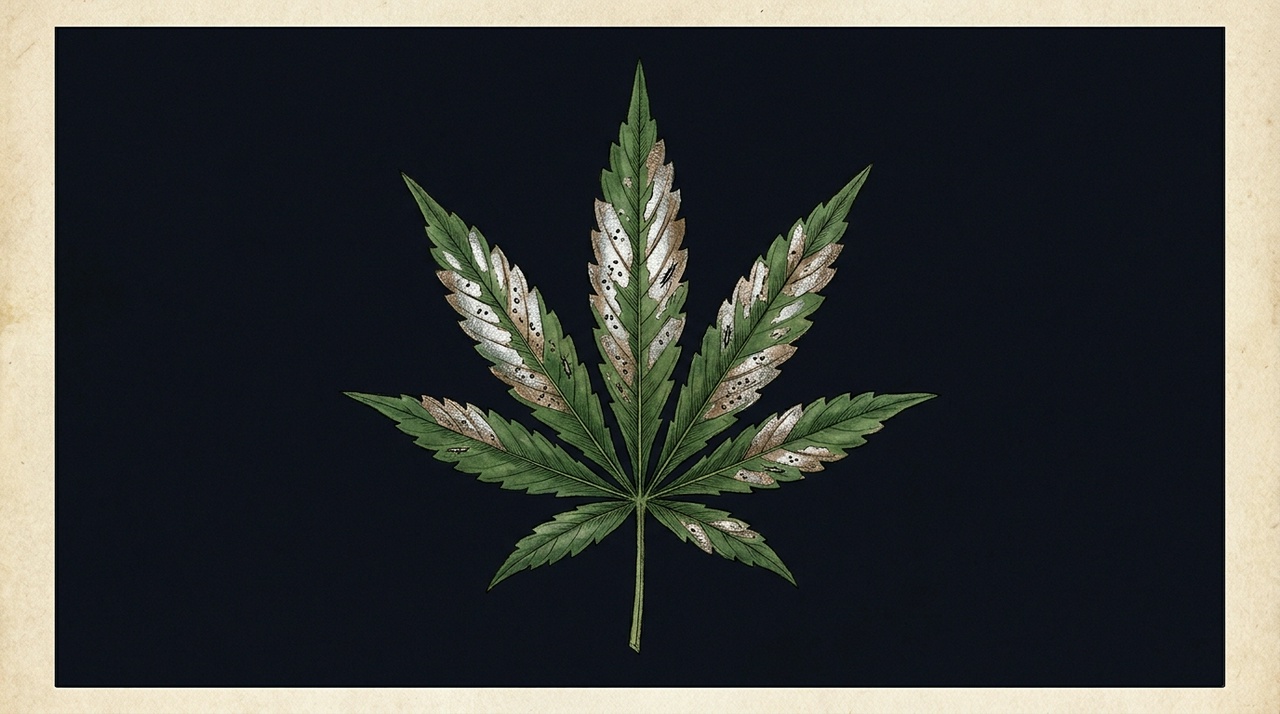
A leaf catches the grow light and something looks off. Not yellow, not spotted – silver. Scratched, almost metallic, like someone dragged fine steel wool across the surface. The first guess is usually the lamp: too close, too bright, a little light burn on the tops.
Then you notice the same sheen on a lower leaf that never gets direct light.
That silver is not light stress. It is what thrips leave behind when they rasp open plant cells and drink the contents, and the metallic look is the emptied tissue reflecting light. Thrips are one of the easiest cannabis pests to misread, because the damage imitates two completely different problems – light burn from above and spider mites from below – and because the insects themselves are small, fast, and easy to miss on a quick look.
This guide covers how to spot thrips early, how to separate them from the things they mimic, and what actually clears them – including the reason thrips are worth taking more seriously than their size suggests.
Quick identification
Thrips are slim, torpedo-shaped insects roughly 1-2mm long. They feed by scraping the leaf surface open and sucking out the cell contents, which leaves silver or bronze streaks with tiny dark specks of frass (droppings) scattered through the damaged zones. Flick an affected leaf and you may see the adults dart or drop – they move fast for their size.
Quick checklist:
- Silver, bronze, or scratched-looking streaks on the upper leaf surface
- Tiny dark specks (frass) sitting inside the silvered areas
- Pinpoint white scars where individual cells were punctured
- Slim, fast-moving insects visible when you flick or shake the leaf
- Pale yellow, translucent larvae on the leaf underside
- No webbing anywhere – that rules the damage toward mites instead
The single most useful tell is the combination of a metallic sheen plus dark specks. Light burn bleaches tissue but leaves nothing sitting on it. Spider mites leave pinprick dots and webbing but no silver sheen. Thrips leave both the sheen and the frass.
Why thrips get misdiagnosed
The damage imitates light burn
Silvering on upper leaves near the canopy top is the classic light-burn pattern, so that is the first thing most growers reach for. They raise the lamp, wait a week, and the silvering keeps spreading – now onto leaves nowhere near the light.
Light burn bleaches evenly across the area under the lamp and stops where the intense light stops. Thrips damage is patchy, streaked, and shows up wherever the insects happen to be feeding, including shaded lower leaves. And light burn never comes with dark specks. If you see frass, it is not the lamp.
The damage imitates spider mites
Look closer and the story flips. Now the surface scarring looks like the early stippling of a spider mite infestation, so the neem comes out and the miticide rotation begins.
The two do overlap, but they separate cleanly on two features. Spider mites leave round pinprick dots and, as populations grow, fine webbing at leaf tips and branch junctions. Thrips leave elongated silver streaks and no webbing at all. Flip the leaf: mites and their eggs cluster on the underside, while thrips larvae are larger, paler, and translucent-yellow.
| Feature | Thrips | Spider mites | Light burn |
|---|---|---|---|
| Surface look | Silver/bronze streaks | Round pinprick dots | Uniform pale bleaching |
| Metallic sheen | Yes | No | No |
| Dark specks (frass) | Yes | No | No |
| Webbing | No | Yes (as it advances) | No |
| Where it starts | Anywhere thrips feed | Lower/inner canopy | Directly under the lamp |
| On the underside | Pale translucent larvae | Mites, eggs, shed skins | Nothing |
The reason thrips matter more than their size
Most of the damage a small thrips population does is cosmetic – scarred leaves lose some photosynthetic surface, but a healthy plant shrugs off a light infestation. The real concern is what thrips carry.
Thrips are among the most efficient virus vectors in horticulture. They transmit tospoviruses, including tomato spotted wilt virus (TSWV) and impatiens necrotic spot virus (INSV), by feeding on an infected plant and then on a healthy one. A plant virus has no cure – there is no spray, no flush, no correction. An infected plant stays infected, and thrips can move the virus through a room faster than you can treat the insects themselves.
This is why thrips are worth catching early even when the leaf damage looks minor. You are not just protecting leaf area. You are cutting off a transmission route before it opens.
Visual symptoms by stage
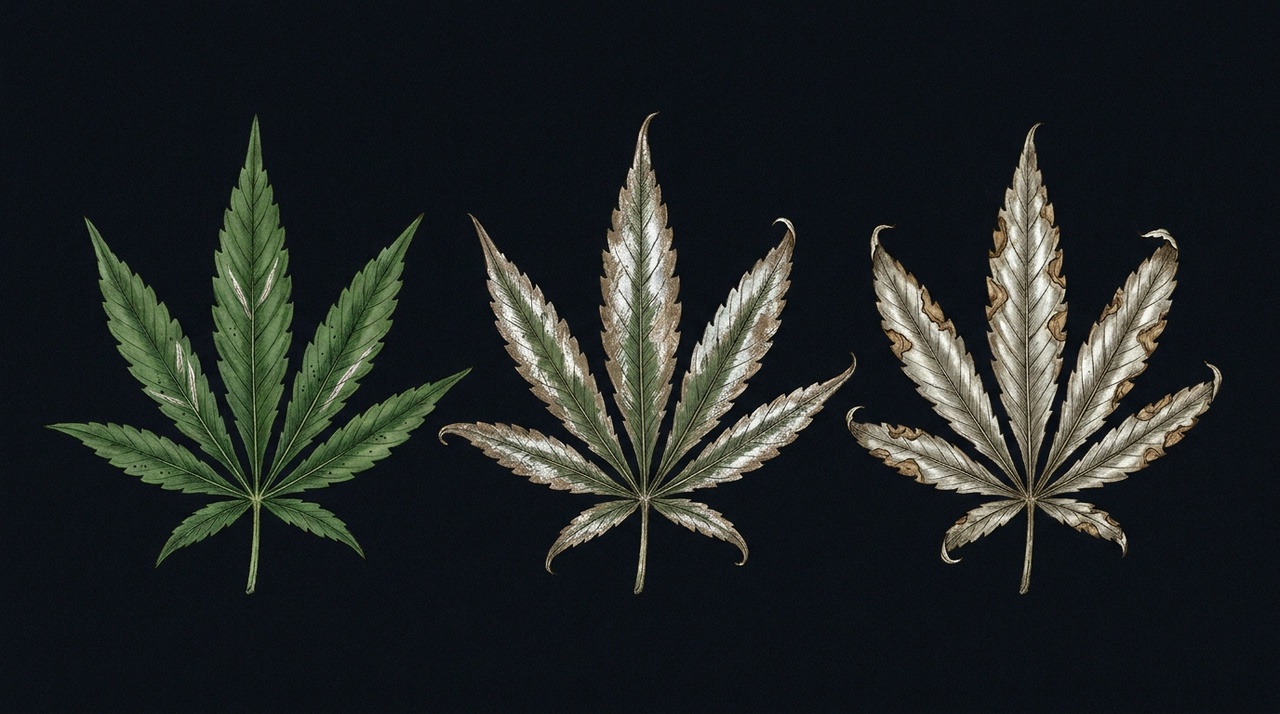
Early
- Faint silver or bronze streaks on a few upper leaves
- A handful of dark frass specks inside the streaks
- Occasional slim insects when you flick the leaf
- Plant otherwise looks healthy
This is the window where treatment is easy and the virus risk is lowest. It is also the window most growers spend blaming the lamp.
Moderate
- Silver-bronze patches across multiple leaves, top and bottom of the plant
- Leaves starting to look scratched, frosted, or dull
- Curling and slight distortion in the worst-hit zones
- Pale translucent larvae visible on undersides
Severe
- Whole leaves turned silvery-bronze with dead, necrotic patches
- Early leaf drop
- Stunted or distorted new growth, sometimes with viral symptoms (ring spots, mottling, wilting that watering does not fix)
- Yield and quality loss if it reaches flower
Where thrips come from
Thrips rarely appear out of nowhere. The common entry points:
- New clones or starts brought in without quarantine – the number-one route
- Outdoor or greenhouse contamination carried in on plants, clothing, or air
- Warm, dry conditions that let generations turn over quickly
- Open vents or shared HVAC with an infested room
- No monitoring cards, so an early population goes unseen
One monitoring detail that trips growers up: thrips are drawn to blue sticky cards more strongly than the yellow ones most people default to. If you are watching for fungus gnats and whitefly with yellow cards but not running blue, you have a blind spot exactly where thrips would show up first.
Treatment
First response
- Isolate affected plants if you can, and pull any heavily scarred leaves (bag them, do not compost)
- Put out blue sticky cards near the canopy to gauge how many adults are flying
- Start a contact treatment on leaf undersides, where larvae sit
What works
- Spinosad – one of the more effective organic-approved options against thrips specifically. Rotate it rather than leaning on it every time, since thrips can build resistance.
- Neem oil (azadirachtin) – disrupts feeding and molting. Apply to undersides. Keep it out of flower – it affects taste and does not fully degrade on flower tissue.
- Insecticidal soap – kills on contact by desiccation, so coverage has to be thorough. Repeat every few days to catch newly hatched larvae.
- Predatory mites – Amblyseius cucumeris and A. swirskii hunt thrips larvae and are the cleanest option for a preventive or in-flower approach, since they leave no residue.
Thrips spend part of their life cycle as pupae in the growing medium, out of reach of foliar sprays. That is why a single spray never finishes the job and why pairing a foliar treatment with soil-level control (beneficial nematodes, or predators that patrol the medium) closes the loop.
In flower
The rules mirror any pest during bloom: sprays that leave residue or affect taste come off the table. Predatory mites and blue-card monitoring are the safe path. If viral symptoms have appeared, be realistic – an infected plant will not recover, and keeping it near healthy plants only extends the thrips' reach.
Prevention
- Quarantine every new clone or plant for 7-14 days and inspect undersides before it joins the room
- Run blue sticky cards continuously, not just once a problem starts – they are your early-warning system
- Keep the environment out of the warm-and-dry zone thrips prefer where your other targets allow
- Inspect the upper and lower canopy weekly – a quick leaf-flick test takes seconds
- Consider preventive predators (A. cucumeris) if you have had thrips before or bring in outside plant material regularly
Catching the pattern before you blame the lamp
Thrips damage is a diagnosis problem before it is a pest problem. The silver sheen reads as light burn, then as spider mites, and each wrong guess costs days – days in which a virus-carrying population keeps feeding and spreading.
PlantLab covers 31 cannabis conditions, thrips among them, and returns a calibrated-confidence read from a single leaf photo in about 18 milliseconds. It is built to flag the silver-streak-plus-specks pattern as thrips rather than let it sit in the “probably the light” pile while the population grows. It does not replace a close look with a loupe – nothing does – but it puts a name on the pattern early, which is exactly where thrips are cheapest to deal with.
Free at plantlab.ai – 3 checks a day.
Related reading
- Spider Mites on Cannabis: Early Detection Before the Damage – the pest thrips are most often confused with, and how to tell the pinprick-and-webbing pattern from silver streaks
- What's Wrong With My Cannabis Plant? A Visual Diagnosis Guide – the full symptom-to-cause quick reference
- Build an Autonomous Plant Health Monitor with Node-RED – automate early pest detection so a photo check happens on a schedule, not after the damage shows
FAQ
How do I tell thrips from spider mites? Thrips leave elongated silver or bronze streaks with dark frass specks and no webbing. Spider mites leave round pinprick dots and, as they spread, fine webbing at leaf tips and branch junctions. Flip the leaf: mites and their eggs sit on the underside, while thrips leave pale, translucent larvae.
Are thrips silver marks the same as light burn? No. Light burn bleaches tissue evenly directly under the lamp and leaves nothing sitting on the surface. Thrips damage is streaked and patchy, shows up on shaded lower leaves too, and comes with dark specks of frass. If you see the specks, it is not the light.
Do thrips ruin a cannabis crop? A light infestation is mostly cosmetic leaf scarring. The bigger risk is that thrips transmit plant viruses such as TSWV and INSV, which have no cure. Catching them early matters more for the virus risk than for the leaf damage itself.
What kills thrips on cannabis? Spinosad is one of the most effective organic options, backed by neem oil and insecticidal soap on leaf undersides, and predatory mites (Amblyseius cucumeris or swirskii) for a residue-free approach. Because thrips pupate in the soil, pair foliar sprays with soil-level control and repeat over two to three weeks.
Why are my sticky cards not catching thrips? Thrips prefer blue sticky cards over the yellow ones most growers use for gnats and whitefly. If you are only running yellow, add blue cards near the canopy for a true early-warning signal.