Fungus Gnats on Cannabis: The Wet-Soil Pest That Looks Like Root Rot
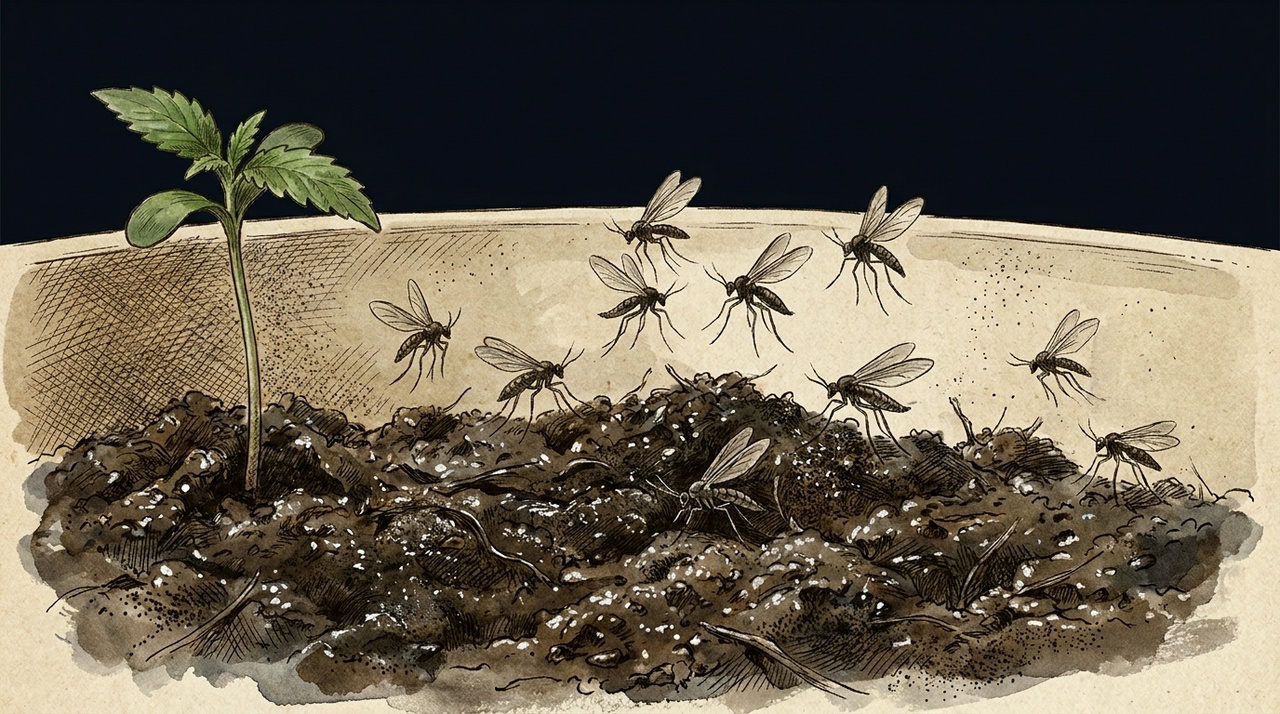
Every time you water, a little cloud of dark flies lifts off the soil, drifts around, and settles back down. They do not bite, they do not swarm the plant, and every forum thread calls them harmless. So you ignore them.
Meanwhile the plant is drooping. Lower leaves are yellowing, growth has slowed, and nothing about your feed or pH explains it. You start treating for overwatering, maybe root rot – and the real cause is still hovering over the pot.
Fungus gnats are the most under-estimated pest in indoor growing. The adults genuinely are close to harmless. The problem is their larvae: tiny translucent worms living in the top layer of wet medium, feeding on root hairs and opening wounds that let real root pathogens in. Because the above-ground symptoms look exactly like a watering or root problem, growers spend weeks fixing the wrong thing while the population builds.
Clearing them is not hard once you know what you are looking at. Getting there is the hard part – past the assumption that the flies are harmless and the droop is just a watering mistake. Here is how to confirm it is gnats, rule out the problems they mimic, and break the cycle instead of swatting adults forever.
Quick identification
Fungus gnats are small dark flies, 2-4mm, that stay near the surface of damp soil and fly weakly in short hops when disturbed. The damage is done by the larvae – translucent, thread-thin worms with a distinct black head – which live in the top 1-2cm of the medium and feed on fine roots.
Quick checklist:
- Small dark flies hopping or drifting just above the topsoil
- Flies lift off when you water or disturb the pot, then resettle
- Adults stuck to yellow sticky cards placed near the medium
- Translucent larvae in the top layer of soil when you scratch it back
- Droop and lower-leaf yellowing that watering changes do not fix
- Topsoil that stays wet for days between waterings
The decisive check is simple: are there flies at the soil surface, and is the medium consistently wet? Two yeses is fungus gnats until proven otherwise. Scratch back the top centimetre and look for the larvae to confirm.
Why fungus gnats get misdiagnosed
Fungus gnats damage roots, and root damage above ground looks like every other root problem: droop, slowed growth, yellowing that creeps up from the bottom. So the symptoms get filed as overwatering or root rot, and the flies get dismissed as a coincidence.
The three conditions live in the same wet-soil neighbourhood, which is exactly why they get confused – and often why they show up together. Chronically wet medium is what invites gnats, drowns roots, and breeds rot all at once.
| Feature | Fungus gnats | Overwatering | Root rot |
|---|---|---|---|
| Flies at soil surface | Yes | No | No |
| Wet, slow-draining medium | Yes | Yes | Usually |
| Wilt pattern | Yellowing, gradual droop | Puffy droop after watering | Persistent wilt, does not recover |
| Roots | Nibbled fine roots, entry wounds | Pale, waterlogged | Brown, slimy, foul-smelling |
| Fix direction | Dry back + kill larvae | Water less, improve drainage | Sterilize, improve oxygen, often too late |
The tell that separates them from the rest is the flies. Overwatering and root rot do not put insects in the air over your pots. If you see the flies and the wet medium together, gnats are in the mix – and there may be more than one problem to solve.
What the larvae actually do
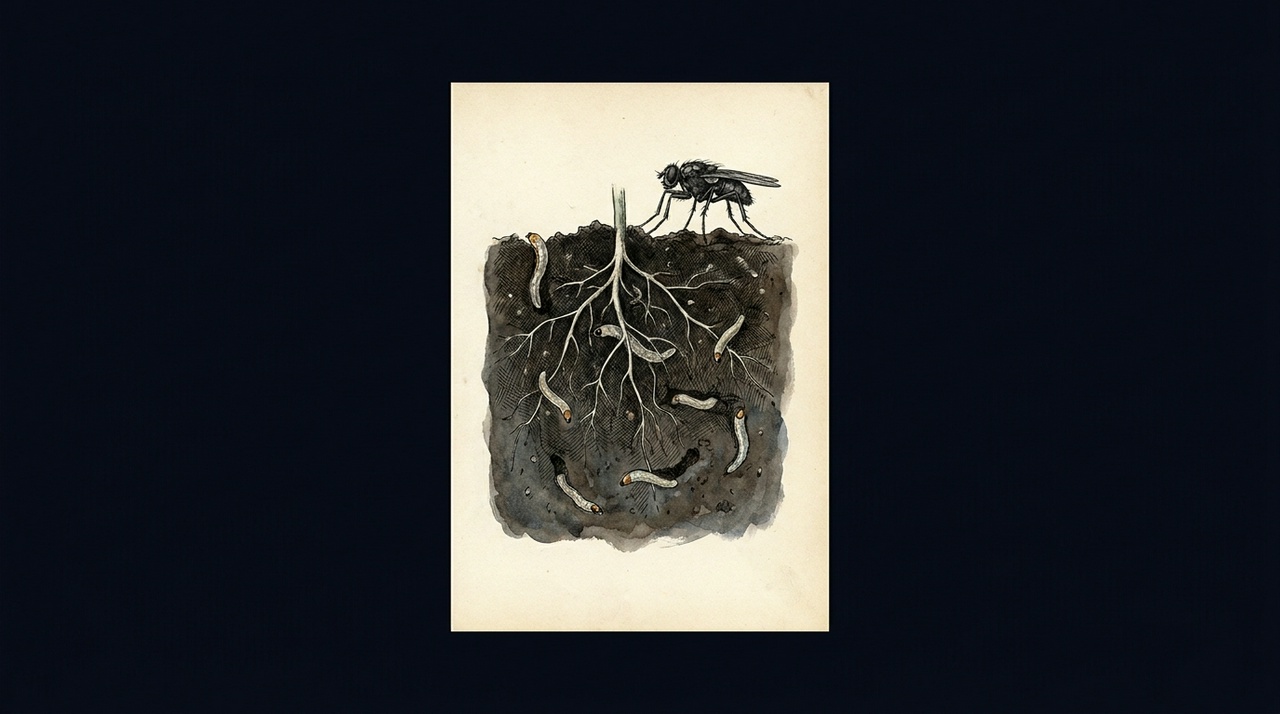
The adults are a nuisance and a warning sign, not the damage. The larvae are the damage.
Living in the wet top layer, fungus gnat larvae graze on root hairs and the fine feeder roots that do most of a plant's water and nutrient uptake. In a seedling or a young clone with a small root system, that alone can stall or kill the plant. In a larger plant the direct feeding matters less – but every feeding wound is an open door. Fungus gnats are a known vector for soil pathogens like Pythium and Fusarium, moving spores through the medium and giving them a wound to colonize. A gnat problem left alone often becomes a root-rot problem, which is a far worse thing to fix.
This is why “just live with a few flies” is bad advice. The flies are the visible edge of a root-zone problem that gets more expensive the longer it runs.
Symptoms by stage
Early
- A few small dark flies drifting over the topsoil
- Adults showing up on yellow sticky cards near the pots
- Plant still looks normal above ground
Moderate
- Several flies per plant, lifting off whenever the soil is disturbed
- Loss of vigor or slight droop the watering schedule does not explain
- Lower leaves yellowing
- Translucent larvae visible in the top 1-2cm when you scratch the surface
Severe
- Heavy adult populations drifting through the whole room
- Stunted growth and yellowing climbing up the canopy
- Persistent wilt and weak structure that reads exactly like root rot
- Actual root pathogens taking hold in the damaged root zone
Where fungus gnats come from
Fungus gnats are a symptom of one thing above all: a topsoil that never dries out. Their eggs and larvae need constant surface moisture, so the root cause is almost always the watering routine or the medium.
- Topsoil staying wet between waterings
- Overwatering, or a heavy, poorly draining medium that holds water at the surface
- Peat or compost-heavy mixes, which arrive with organic matter gnats feed on and sometimes with eggs already in them
- New medium contaminated with eggs or larvae
- Open windows and doors letting adults migrate in from houseplants or outside
Fix the moisture and you remove the habitat. Everything below is about killing the current generation while you do that.
Treatment
The winning approach hits two targets at once: dry out the surface the larvae need, and kill the larvae and adults directly. Do one without the other and the population just rebuilds.
Break the moisture cycle
- Let the top 2-3cm dry out fully between waterings. This alone kills eggs and young larvae and stops new eggs from surviving.
- Water from the bottom where practical, keeping the surface dry while the roots still drink.
- Improve drainage – amend heavy medium, and never let pots sit in standing runoff.
- Add a dry barrier on top – a 1-2cm layer of coarse sand, or horticultural grit – so adults cannot reach the medium to lay eggs.
Kill the current generation
- Bti (Bacillus thuringiensis israelensis) – the standard larvae killer, sold as mosquito bits or dunks. Soak it into your water and drench the medium. It targets gnat and mosquito larvae specifically and is harmless to the plant.
- Beneficial nematodes (Steinernema feltiae) – a living soil-drench control that hunts larvae in the medium. Strong choice for a persistent or recurring problem.
- Yellow sticky cards flat or near the surface – these catch adults, cut the next generation, and double as your monitoring tool.
- Hydrogen peroxide drench (diluted) – kills larvae on contact and adds oxygen to the root zone. A useful knock-down, though Bti and nematodes are better for lasting control.
Predatory options like Hypoaspis (soil-dwelling mites) also work well for growers who prefer a fully biological program.
Prevention
- Water on a dry-back, not a schedule – let the surface dry before the next water. This is the single most effective prevention there is.
- Bottom-water to keep the top layer dry
- Run yellow sticky cards continuously as an early-warning system, not just once a problem starts
- Quarantine and inspect new medium and new plants before they enter the room
- Keep the space clean – no standing water, no decaying plant matter, no algae on wet surfaces (gnats feed on it)
Telling gnats from the root problems they mimic
Bti and a dry-back clear fungus gnats reliably. What trips growers up is getting to that point, because gnats, overwatering, and root rot all arrive together in wet soil and all droop and yellow the same way. Weeks go into treating a watering problem while the larvae keep working on the roots.
PlantLab covers 31 cannabis conditions, fungus gnats among them, and returns a calibrated-confidence read from a single photo in about 18 milliseconds. Where flies are visible near the medium, it is built to call fungus gnats rather than let the droop get filed as generic overwatering – the misread that lets larvae keep working on the roots for another two weeks. It is not a substitute for scratching back the topsoil and looking – that is always the confirmation – but it points you at the soil surface early, before a gnat problem turns into a root-rot problem.
Free at plantlab.ai – 3 checks a day.
Related reading
- Bud Rot and Root Rot on Cannabis: Detection Before It's Too Late – where a neglected gnat problem often ends up, and how to catch root rot before it spreads
- What's Wrong With My Cannabis Plant? A Visual Diagnosis Guide – the full symptom-to-cause quick reference
- Build an Autonomous Plant Health Monitor with Node-RED – tie a photo check and a dry-back rule together so wet-soil pests get caught automatically
FAQ
Are fungus gnats harmful to cannabis? The adult flies are mostly a nuisance, but the larvae feed on fine roots in the top layer of wet soil and open wounds that let root pathogens in. On seedlings and clones they can stall or kill the plant outright; on larger plants they set up the conditions for root rot. They are worth clearing early.
How do I tell fungus gnats from root rot? Fungus gnats put small dark flies in the air over your pots; root rot does not. Root rot shows brown, slimy, foul-smelling roots and a persistent wilt that watering never fixes. The two often occur together in chronically wet medium, so treat the gnats and check the roots.
What kills fungus gnats fast? Bti (mosquito bits or dunks) soaked into your water kills the larvae, and yellow sticky cards knock down the adults. Pair that with letting the top 2-3cm of soil dry out between waterings. For a stubborn or recurring case, add beneficial nematodes.
Why do I keep getting fungus gnats? Because the topsoil is staying wet. Their eggs and larvae need constant surface moisture, so the fix is a dry-back watering routine, better drainage, or bottom-watering. A dry surface removes the habitat and prevents the next generation.
Do fungus gnats go away on their own? Rarely, as long as the medium stays wet – they keep breeding in the moist surface layer. Drying out the top of the soil and running Bti or sticky cards is what actually ends the cycle.